Commercial concrete floors endure relentless punishment from heavy machinery, chemical spills, constant foot traffic, and environmental exposure. Without proper protection, even the most expertly poured concrete surfaces deteriorate rapidly, leading to costly repairs and operational disruptions. Commercial concrete sealing provides a critical protective barrier that extends floor lifespan, reduces maintenance requirements, and maintains safe working conditions across warehouses, factories, retail spaces, and industrial facilities throughout South East Queensland.
Understanding Commercial Concrete Sealing
Commercial concrete sealing involves applying specialised chemical formulations to concrete surfaces to create a protective barrier against moisture, chemicals, abrasion, and environmental degradation. Unlike residential applications, commercial concrete sealing demands industrial-grade products designed to withstand extreme conditions and heavy-duty use.
The process fundamentally changes how concrete interacts with its environment. Unsealed concrete acts like a sponge, absorbing liquids, oils, and contaminants that gradually break down the surface structure. This porosity leads to staining, dusting, cracking, and eventual structural compromise.
Primary Functions of Concrete Sealers
Concrete sealers serve multiple protective functions:
- Moisture barrier preventing water penetration and freeze-thaw damage
- Chemical resistance protecting against acids, oils, solvents, and cleaning agents
- Surface hardening reducing wear from traffic and mechanical equipment
- Dust suppression eliminating concrete dust generation
- Stain prevention blocking absorption of spills and contaminants
- Enhanced cleanability simplifying maintenance and hygiene protocols
Different facility types require specific sealing solutions. Warehouse flooring often benefits from penetrating sealers that strengthen the surface whilst maintaining traction, whereas retail environments might prioritise aesthetic enhancement alongside protection.

Types of Commercial Concrete Sealers
The Australian commercial flooring market offers numerous sealer categories, each engineered for specific applications and performance requirements. Selecting the appropriate product requires understanding both the sealer chemistry and the operational demands of your facility.
Penetrating Sealers
Penetrating sealers chemically react with concrete to create protection from within the slab. These products include silicates, silanes, and siloxanes that penetrate several millimetres below the surface.
Silicate densifiers react with calcium hydroxide in concrete to form additional calcium silicate hydrate, the compound that gives concrete its strength. This process literally hardens the surface whilst filling microscopic pores.
| Sealer Type | Penetration Depth | Longevity | Best Applications |
|---|---|---|---|
| Sodium Silicate | 3-6mm | 5-7 years | Warehouses, car parks |
| Lithium Silicate | 6-10mm | 7-10 years | Industrial workshops, factories |
| Silane/Siloxane | 3-12mm | 3-5 years | Outdoor concrete, exposed areas |
Penetrating sealers maintain the natural appearance of concrete and don’t create a surface film that can wear away or peel. They’re particularly effective for car park flooring where tire traffic would quickly degrade topical coatings.
Topical Sealers
Topical sealers create a protective film on the concrete surface. This category includes acrylics, polyurethanes, and epoxy-based products that bond to the surface rather than penetrating it.
Acrylic sealers provide basic protection and aesthetic enhancement at an economical price point. Available in solvent-based or water-based formulations, acrylics offer varying levels of gloss whilst protecting against light chemical exposure and moisture intrusion.
Polyurethane sealers deliver superior durability compared to acrylics, with excellent abrasion resistance and chemical protection. These products suit high-traffic commercial environments where appearance and performance both matter. For facilities requiring food-grade certification, polyurethane options meet stringent health and safety standards for food process flooring.
Benefits of Sealing Commercial Concrete
The financial and operational advantages of sealing commercial concrete surfaces extend far beyond basic surface protection. Properly sealed floors deliver measurable returns through reduced maintenance costs, extended service life, and improved facility safety.
Extended Floor Lifespan
Unsealed concrete in commercial environments typically shows significant degradation within 3-5 years. Surface dusting, minor cracking, and staining become visible within months of installation. Sealing immediately after proper curing extends functional floor life by 200-300%, delaying or eliminating the need for costly resurfacing or replacement.
The protection compounds when combined with proper maintenance protocols. Sealed surfaces resist the freeze-thaw cycling that causes spalling in outdoor or unheated facilities. Chemical resistance prevents the etching and deterioration that occurs when oils, solvents, or cleaning chemicals contact bare concrete.
Reduced Maintenance Requirements
Concrete sealing benefits include dramatically simplified cleaning and maintenance. Sealed surfaces resist staining, allowing spills to be wiped away before absorption occurs. This characteristic proves invaluable in mechanical workshop flooring where hydraulic fluids, oils, and solvents frequently contact the floor.
Dust suppression represents another significant maintenance advantage. Unsealed concrete constantly generates fine dust particles as the surface abrades under traffic. This dust settles on equipment, products, and ventilation systems, requiring constant cleaning. Quality sealers eliminate this dust generation, maintaining cleaner working environments and reducing HVAC maintenance.
Enhanced Safety Performance
Workplace safety improves measurably with properly sealed concrete. The right sealer formulation creates consistent traction characteristics across the entire floor surface, reducing slip hazards. Many commercial sealers incorporate anti-slip additives that maintain grip even when wet.
Visual safety benefits include:
- Improved lighting reflectivity reducing shadows and dark areas
- Clear line marking visibility for traffic patterns and safety zones
- Easier detection of spills and potential hazards
- Consistent surface appearance eliminating trip hazards from surface irregularities
Selecting the Right Sealer for Your Facility
Choosing appropriate sealing products requires analysing multiple facility-specific factors. The wrong sealer selection leads to premature failure, wasted investment, and potential operational disruptions during reapplication.
Traffic and Load Considerations
Heavy forklift traffic demands different protection than foot traffic alone. Point loading from pallet jacks and material handling equipment creates concentrated stress that can break through inadequate sealer films. Factory flooring applications typically require either robust penetrating densifiers or high-build epoxy systems that can withstand sustained mechanical abuse.
Light commercial applications such as retail flooring prioritise aesthetics alongside moderate protection. These environments benefit from clear polyurethane sealers that enhance the concrete’s natural appearance whilst providing adequate protection against foot traffic and occasional spills.
Chemical Exposure Assessment
Facilities must inventory the chemicals regularly contacting floor surfaces. Different sealers offer varying resistance to specific chemical families:
| Chemical Type | Recommended Sealer | Resistance Duration |
|---|---|---|
| Petroleum oils | Epoxy or polyurethane | Excellent (continuous exposure) |
| Acids (pH < 4) | Specialised acid-resistant epoxy | Good (intermittent exposure) |
| Alkalis (pH > 10) | Silicate densifiers | Excellent (continuous exposure) |
| Solvents | High-grade polyurethane | Moderate (intermittent exposure) |
Commercial kitchens and food processing facilities face unique challenges from hot water, cleaning chemicals, and organic acids. These environments require food-grade sealing solutions that maintain chemical resistance whilst meeting health department standards.
Environmental Conditions
South East Queensland’s subtropical climate influences sealer selection and performance. High humidity, temperature fluctuations, and intense UV exposure in outdoor or open-air facilities degrade certain sealer types rapidly.
Moisture vapour transmission through concrete slabs can cause film-forming sealers to bubble and delaminate. This issue particularly affects ground-level slabs without adequate vapour barriers. Penetrating sealers allow moisture vapour to escape whilst still providing surface protection, making them suitable for problematic slabs.
Surface Preparation Requirements
The most expensive, high-performance sealer fails without proper surface preparation. Commercial concrete sealing success depends 80% on preparation quality and only 20% on product selection.
Concrete Age and Curing
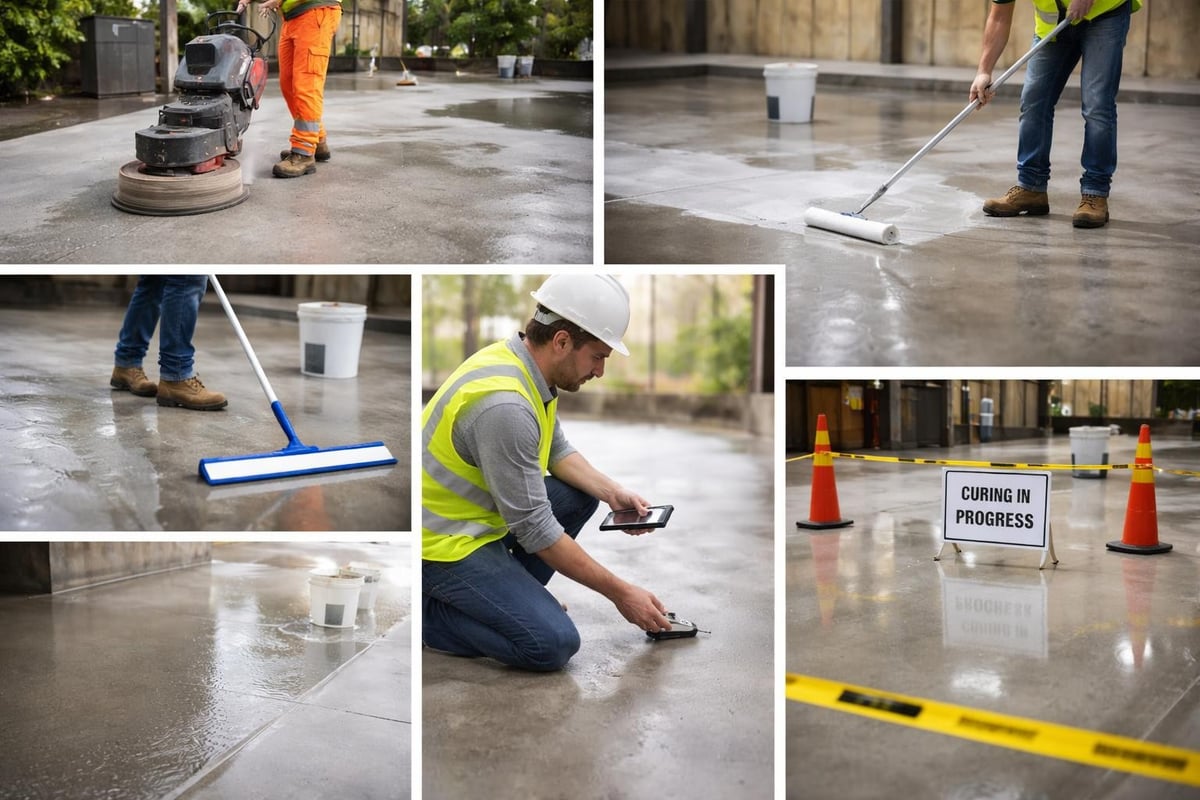
New concrete requires complete curing before sealing. Applying sealers to insufficiently cured concrete traps moisture and prevents proper strength development. Most commercial specifications require 28-day curing for standard mixes, though rapid-cure formulations may allow earlier sealing.
Testing concrete moisture content before sealing prevents costly failures. Calcium chloride tests or electronic moisture metres determine whether concrete has dried sufficiently for sealer application. Acceptable moisture levels vary by sealer type, with most penetrating products tolerating higher moisture than topical films.
Cleaning and Decontamination
Existing floors require thorough cleaning to remove contaminants that prevent sealer adhesion. Oil stains, previous coatings, curing compounds, and surface laitance must be completely removed.
Professional cleaning methods include:
- Mechanical grinding to remove surface contamination and open pores
- Chemical degreasing for oil and grease removal
- Acid etching to neutralise alkaline residues and improve profile
- Shot blasting for aggressive contamination removal
- Pressure washing for final cleaning before application
Reputable companies like Souffront Construction and Engineering emphasise the importance of thorough surface preparation in their concrete restoration projects, demonstrating how proper preparation protocols ensure long-term performance across commercial and industrial applications.
Profile Requirements
Different sealers require specific surface profiles for optimal bonding. The International Concrete Repair Institute (ICRI) defines Concrete Surface Profile (CSP) standards from CSP 1 (nearly smooth) to CSP 10 (heavily profiled).
Penetrating sealers typically require minimal profile (CSP 1-2), as they rely on chemical reaction rather than mechanical bonding. Topical sealers need more texture (CSP 2-4) to create adequate mechanical adhesion. Polished concrete flooring represents the smoothest end of the spectrum, yet still accepts certain sealer types designed for dense, refined surfaces.

Application Methods and Techniques
Professional application separates adequate sealing from superior long-term performance. Commercial environments demand precise application techniques that ensure complete coverage, proper mil thickness, and consistent curing.
Equipment Selection
Commercial-scale sealing requires industrial application equipment matched to both product viscosity and facility size. Small facilities under 500 square metres may use pump sprayers or roller application. Larger warehouses and industrial spaces require truck-mounted or walk-behind spray systems for efficient coverage.
Airless sprayers provide the most consistent application for low-viscosity penetrating sealers. These systems atomise the sealer into fine particles that penetrate concrete pores effectively. High-pressure airless sprayers handle thicker polyurethane and epoxy products whilst maintaining even mil thickness.
Environmental Controls
Temperature and humidity dramatically affect sealer performance during application and curing. Most commercial sealers specify application temperatures between 10°C and 32°C, with relative humidity below 85%.
Queensland’s climate requires careful scheduling. Summer applications face rapid evaporation that can prevent proper penetration or film formation. Winter applications in unheated facilities risk condensation interfering with curing. Professional applicators monitor substrate temperature, ambient temperature, and humidity throughout the application process.
Coverage Rates and Film Thickness
Manufacturer-specified coverage rates provide starting points, but actual consumption varies based on concrete porosity, surface profile, and ambient conditions. New concrete typically absorbs more sealer than aged, densified surfaces.
Standard application protocols include:
- First coat at manufacturer’s recommended rate
- Dwell time allowing penetration or initial cure
- Second coat applied perpendicular to first coat direction
- Quality inspection checking for missed areas or pooling
- Curing period before returning facility to service
For facilities that require comprehensive floor protection systems, epoxy flooring combines sealing properties with a durable wearing surface that withstands extreme chemical and mechanical abuse.

Maintenance and Reapplication Schedules
Sealed concrete requires ongoing maintenance to preserve protection and appearance. Neglecting maintenance eliminates the benefits of sealing within months, as accumulated contamination and wear compromise the protective barrier.
Routine Cleaning Protocols
Daily maintenance for sealed commercial concrete involves dust mopping or sweeping to remove abrasive particles. Weekly protocols include damp mopping with pH-neutral cleaners that won’t degrade the sealer chemistry.
Avoid harsh chemicals not specifically approved for sealed concrete. Acidic cleaners etch some sealers, whilst strong alkalis can soften certain topical films. Many facilities implement colour-coded cleaning systems to prevent cross-contamination from chemicals used in other facility areas.
Inspection and Performance Monitoring
Quarterly inspections identify early sealer degradation before major failure occurs. Inspectors examine high-traffic areas, chemical exposure zones, and previous problem areas for signs of:
- Surface dulling or gloss loss
- Increased staining susceptibility
- Return of concrete dusting
- Water absorption (indicating lost water resistance)
- Film delamination or bubbling
Understanding concrete sealing fundamentals helps facility managers recognise when maintenance or resealing becomes necessary. Early intervention through spot repairs or maintenance coats costs significantly less than complete floor resealing.
Resealing Frequency
Penetrating sealers typically require reapplication every 3-7 years depending on traffic levels and environmental exposure. Topical sealers need more frequent attention, with high-traffic areas requiring recoating every 1-3 years.
| Facility Type | Traffic Level | Recommended Resealing Interval |
|---|---|---|
| Warehouse | Heavy forklift | 2-3 years |
| Retail store | Moderate foot | 3-5 years |
| Car park | Heavy vehicle | 3-4 years |
| Workshop | Variable equipment | 2-4 years |
| Factory | Heavy industrial | 1-3 years |
Some facilities implement staged resealing, addressing high-wear areas annually whilst treating the entire floor on longer cycles. This approach maintains consistent protection whilst spreading capital expenditure across budget periods.
Common Sealing Challenges and Solutions
Even properly specified and applied commercial concrete sealing encounters challenges in demanding environments. Understanding common issues enables proactive prevention and effective remediation when problems occur.
Moisture-Related Failures
Hydrostatic pressure from groundwater or inadequate vapour barriers pushes moisture through concrete slabs. This moisture accumulates beneath topical sealers, causing blistering, bubbling, and delamination.
Solution approaches include installing proper drainage systems, applying moisture-mitigating primers, or switching to breathable penetrating sealers that allow vapour transmission. Calcium chloride moisture testing before sealing identifies problematic slabs requiring special treatment.
Adhesion Failures
Sealers that fail to bond properly peel, flake, or wear away in patches. Adhesion failures stem from contaminated surfaces, incompatible products, or inadequate surface profile.
Prevention requires thorough surface preparation and product compatibility testing. When existing coatings or sealers are present, complete removal typically proves more reliable than attempting to seal over questionable surfaces. Commercial surface polishing can remove failing coatings whilst creating an ideal substrate for new sealer application.
Wear Patterns and Traffic Damage
High-traffic pathways wear through sealers faster than surrounding areas, creating unsightly patterns and exposing vulnerable concrete. Forklift turning zones and entrance areas experience concentrated abuse.
Addressing this challenge requires either specifying more durable sealers for high-wear areas or implementing more frequent maintenance coating schedules. Some facilities use hybrid approaches, applying penetrating densifiers facility-wide with additional topical protection in critical zones.
Cost Considerations and ROI
Commercial concrete sealing represents a significant capital investment requiring careful financial justification. However, comprehensive cost analysis reveals compelling returns through extended floor life, reduced maintenance, and avoided replacement costs.
Initial Investment Breakdown
Sealing costs vary widely based on product selection, surface preparation requirements, and facility size. South East Queensland commercial projects typically range from $8 to $25 per square metre for professional sealing services.
Budget components include:
- Surface preparation (30-40% of total cost)
- Sealer material (25-35% of total cost)
- Labour and application (25-35% of total cost)
- Facility downtime (opportunity cost varies by operation)
Large facilities benefit from economies of scale, with per-square-metre costs decreasing as project size increases. How to seal commercial concrete effectively requires balancing budget constraints against performance requirements and expected service life.
Long-Term Financial Benefits
Properly sealed concrete floors deliver measurable returns throughout their service life. Unsealed concrete in commercial environments requires replacement or resurfacing every 5-10 years at costs exceeding $100 per square metre. Quality sealing extends this timeline to 15-25 years whilst reducing annual maintenance costs by 40-60%.
Additional financial benefits include:
- Reduced product damage from floor contamination
- Lower cleaning labour and chemical costs
- Decreased HVAC maintenance from dust reduction
- Improved property valuation and tenant appeal
- Enhanced workplace safety reducing injury-related costs
Comparing Sealing Options
Decision-makers often evaluate sealing against alternative floor protection strategies. While products like epoxy coating systems offer superior protection and aesthetics, they require significantly higher initial investment.
| Solution | Initial Cost/m² | Expected Life | Annual Cost/m² |
|---|---|---|---|
| No treatment | $0 | 5 years | $20+ (replacement) |
| Penetrating sealer | $10-15 | 7 years | $1.40-2.15 |
| Topical sealer | $12-18 | 4 years | $3.00-4.50 |
| Epoxy system | $60-120 | 15 years | $4.00-8.00 |
Budget-conscious facilities often implement staged approaches, sealing new concrete immediately whilst scheduling upgrades to higher-performance systems during planned facility improvements.
Regulatory and Safety Compliance
Commercial concrete sealing in Queensland requires adherence to building codes, workplace health and safety regulations, and environmental protection standards. Professional contractors maintain compliance through proper licensing, insurance, and certified application protocols.
Building and Construction Standards
The Queensland Building and Construction Commission (QBCC) regulates commercial flooring work, requiring licensed contractors for projects exceeding specified thresholds. Proper licensing ensures contractors maintain adequate insurance, technical competence, and financial accountability.
Sealing work forming part of new construction or major renovations must comply with the National Construction Code (NCC) and relevant Australian Standards. Slip resistance standards (AS 4586) specify minimum coefficients of friction for commercial walking surfaces, requiring sealers that maintain compliant traction.
Workplace Health and Safety
Sealer application involves chemicals requiring careful handling and application controls. Work Health and Safety Queensland mandates Safety Data Sheet (SDS) compliance, proper ventilation, personal protective equipment, and worker training for commercial sealing operations.
Facilities must coordinate sealing work to minimise occupant exposure to fumes and prevent access to wet surfaces. Professional contractors schedule applications during off-hours, implement ventilation protocols, and use low-VOC products meeting indoor air quality standards.
Environmental Compliance
Queensland environmental regulations govern disposal of spent sealer, contaminated wash water, and surface preparation waste. Protecting commercial concrete surfaces responsibly requires proper waste collection, approved disposal methods, and documentation of environmental compliance.
Water-based sealers generally offer environmental advantages over solvent-based products, though performance requirements sometimes necessitate solvent formulations. Professional applicators maintain spill containment equipment and follow environmental management plans for commercial projects.
Selecting a Qualified Sealing Contractor
The quality of commercial concrete sealing depends heavily on contractor expertise, equipment capabilities, and commitment to proper protocols. Queensland facility managers should evaluate contractors based on comprehensive criteria beyond simple price comparison.
Licensing and Insurance Verification
Verify QBCC licensing appropriate to project scope and value. Licensed contractors maintain statutory warranties, insurance coverage, and accountability through the regulatory framework. Request proof of current insurance including public liability and workers compensation coverage adequate for your facility size.
Industry certifications from product manufacturers indicate contractor training and approved applicator status. Many commercial sealer manufacturers require certification before warranting product performance, making this verification essential for long-term protection.
Project Portfolio and References
Evaluate contractor experience with similar facility types, sealer products, and project scales. Warehouses require different expertise than retail spaces or food processing facilities. Request references from comparable projects completed within the past 2-3 years.
Reviewing completed project portfolios at facilities like Superior Concrete Finishes demonstrates the range and quality of previous work. Site visits to completed projects reveal real-world sealer performance under similar conditions to your facility.
Quality Assurance Protocols
Professional contractors implement documented quality systems covering surface preparation, product selection, application procedures, and post-completion inspection. Request detailed application specifications outlining surface preparation methods, coverage rates, application techniques, and curing requirements.
Quality contractors provide comprehensive warranties covering both labour and materials for specified periods. Warranty terms should clearly define coverage, exclusions, maintenance requirements, and claim procedures to avoid disputes if problems develop.
Commercial concrete sealing delivers essential protection that extends floor life, reduces maintenance costs, and maintains safe working conditions across industrial and commercial facilities. The investment in proper sealing, combined with regular maintenance, prevents the costly deterioration that affects unsealed concrete surfaces. If you’re managing warehouses, factories, retail stores, or industrial facilities throughout South East Queensland, Superior Concrete Finishes brings decades of expertise in commercial concrete protection, offering professional sealing solutions backed by full QBCC licensing and comprehensive insurance coverage. Contact our team to discuss how proper concrete sealing can protect your facility investment and reduce long-term flooring costs.

Joshua Miller has over 15 years of experience in the commercial concrete flooring industry, specialising in epoxy flooring systems and polished concrete solutions for warehouses, factories, retail spaces and commercial developments. Joshua and his team work closely with builders, property owners and facility managers across South East Queensland to deliver durable, cost-effective commercial flooring systems for warehouses, industrial facilities, commercial kitchens, retail stores and large commercial developments.
Major builders and organisations Josh has led projects on include McNab, Hutchinson Builders, IKEA, Queensland Rail, University of Queensland, ADCO, Tomkins Commercial, Bunnings, OfficeWorks, Spotlight, and Anaconda.
If you're planning a project and need advice on the best commercial concrete flooring solution, contact Josh or one of the team at Superior Concrete Finishes.
-
 info@superiorconcretefinishes.com.au
-
1300 789 740
-
Connect with Josh on
LinkedIn


 Connect with Josh on