
Commercial epoxy floor coating has become the gold standard for industrial and commercial facilities across Australia, offering unparalleled durability, chemical resistance, and long-term value. As businesses seek flooring solutions that withstand heavy traffic, harsh chemicals, and demanding operational requirements, epoxy coating systems continue to dominate the commercial flooring landscape. Understanding the technical specifications, application processes, and performance characteristics of commercial epoxy floor coating enables facility managers and business owners to make informed decisions that protect their infrastructure investment while enhancing workplace safety and productivity.
Understanding Commercial Epoxy Floor Coating Systems
Commercial epoxy floor coating is a high-performance flooring solution created through a chemical reaction between epoxy resin and hardener components. This process produces a rigid, thermoset plastic material that bonds permanently to prepared concrete substrates, creating a seamless, durable surface capable of withstanding extreme conditions.
The chemistry behind epoxy systems distinguishes them from simple paint or sealers. When properly formulated and applied, these coatings penetrate the concrete pores, forming a molecular bond that becomes integral to the substrate itself. This fundamental characteristic explains why professional-grade epoxy systems outperform alternative flooring materials in demanding environments.
Key Components and Chemical Properties
Modern commercial epoxy floor coating systems consist of multiple layers, each serving specific functions:
- Primer layer: Penetrates the concrete substrate, ensuring optimal adhesion and moisture management
- Base coat: Provides the primary thickness and structural integrity of the coating system
- Top coat: Delivers chemical resistance, UV stability, and wear resistance
- Optional additives: Anti-slip aggregates, antimicrobial agents, or conductive materials for specialised applications
The performance characteristics vary significantly based on formulation. 100% solids epoxy systems contain no volatile organic compounds (VOCs) and cure to full thickness, making them ideal for heavy industrial applications. Water-based epoxy formulations offer lower odour and easier cleanup, suitable for occupied facilities requiring minimal operational disruption.
Industry Applications and Sector-Specific Requirements
Different commercial sectors demand specific performance attributes from their flooring systems. Understanding these requirements ensures appropriate specification and long-term satisfaction.
| Industry Sector | Primary Requirements | Recommended Coating Type |
|---|---|---|
| Warehousing & Distribution | Impact resistance, forklift traffic tolerance, abrasion resistance | 100% solids epoxy, 3-5mm thickness |
| Food Processing | Chemical resistance, hygiene compliance, easy cleaning | Food-grade epoxy with antimicrobial properties |
| Manufacturing | Chemical resistance, thermal shock tolerance, heavy machinery support | Industrial-grade epoxy with aggregate reinforcement |
| Retail Environments | Aesthetic appeal, moderate traffic resistance, quick installation | Decorative epoxy systems, 2-3mm thickness |
| Automotive Workshops | Oil and chemical resistance, stain resistance, easy maintenance | Solvent-resistant epoxy with sealed surface |
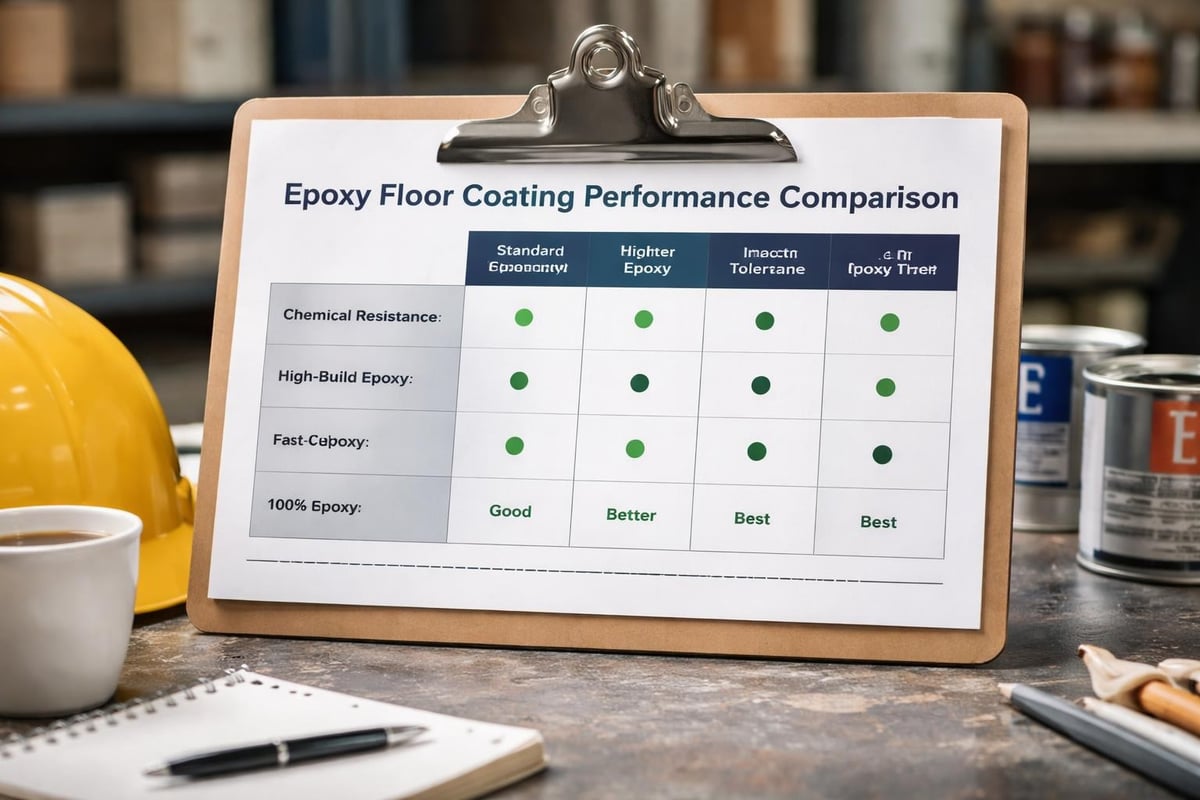
Warehouses and Distribution Centres
Warehouses require flooring that tolerates constant forklift traffic, pallet jacks, and heavy goods movement. Commercial epoxy floor coating systems designed for these environments typically incorporate high-build formulations with aggregate reinforcement to resist point loading and impact damage. The seamless nature of epoxy prevents dust generation, protecting inventory from contamination while simplifying cleaning protocols.
For workshop epoxy flooring applications, durability becomes paramount as these spaces endure dropped tools, chemical spills, and heavy equipment movement throughout each workday.
Commercial Kitchens and Food Processing
Food-grade environments demand specialised food-grade flooring that meets stringent hygiene standards while resisting thermal shock, water exposure, and aggressive cleaning chemicals. Commercial epoxy floor coating systems for these applications incorporate antimicrobial additives and seamless installation techniques that eliminate bacterial harbourage points.
The Australian food safety standards require flooring materials that facilitate thorough cleaning and resist degradation from hot water washdowns and chemical sanitisers. Epoxy systems specifically formulated for commercial kitchens include enhanced chemical resistance and thermal stability to meet these demanding requirements.
Installation Process and Quality Assurance
Successful commercial epoxy floor coating installation depends entirely on proper concrete preparation and environmental control. The comprehensive installation process follows strict protocols ensuring optimal performance and longevity.
Concrete Substrate Preparation
Surface preparation represents the most critical phase of any commercial epoxy floor coating project. Inadequate preparation accounts for the majority of coating failures, making this step non-negotiable for professional installations.
The concrete surface must be:
- Mechanically profiled using diamond grinding or shot blasting equipment
- Thoroughly cleaned to remove all contaminants, oils, and existing coatings
- Moisture tested to ensure relative humidity levels below 75%
- Structurally sound with all cracks and defects properly repaired
- Chemically neutral with pH levels between 7 and 9
Professional contractors invest heavily in preparation equipment because proper surface profile directly correlates with coating adhesion and long-term performance. The concrete surface profile (CSP) should achieve CSP-2 to CSP-3 according to industry standards, creating the necessary mechanical anchor for epoxy adhesion.
Application Methodology and Environmental Controls
Commercial epoxy floor coating application requires precise environmental control and technical expertise. Ambient temperature, relative humidity, and substrate temperature all influence curing chemistry and final properties.
Critical environmental parameters:
- Ambient temperature: 10°C to 30°C during application and cure
- Relative humidity: Below 85% to prevent moisture contamination
- Substrate temperature: Minimum 3°C above dew point
- Ventilation: Adequate air movement without dust contamination
Professional applicators monitor these conditions continuously throughout the installation process, adjusting work schedules and application techniques to maintain optimal conditions. The commercial epoxy flooring installation timeline typically spans 3-7 days depending on coating thickness and cure requirements.
Experienced commercial epoxy flooring contractors understand that rushing the curing process compromises coating properties, leading to premature failure and costly remediation.
Performance Benefits and Value Proposition
Commercial epoxy floor coating delivers measurable return on investment through multiple performance advantages that translate directly to operational efficiency and cost reduction.
Durability and Longevity
When properly installed on well-prepared concrete, commercial epoxy floor coating systems routinely exceed 15-20 years of service life in demanding industrial environments. This longevity stems from the coating's exceptional resistance to:
- Abrasion wear from foot traffic, vehicles, and material handling equipment
- Impact damage from dropped objects and heavy machinery
- Chemical attack from oils, solvents, acids, and alkaline substances
- Moisture intrusion that degrades conventional concrete surfaces
The durability of epoxy flooring significantly outperforms alternative materials like tiles, vinyl, or untreated concrete, reducing long-term maintenance costs and minimising operational disruptions from floor repairs.
Chemical Resistance and Safety Compliance
Industrial facilities handling chemicals, fuels, or corrosive substances require flooring that maintains structural integrity under constant exposure. Commercial epoxy floor coating formulations provide excellent resistance to most common industrial chemicals, protecting the concrete substrate from degradation while simplifying spill cleanup procedures.
The benefits extend to workplace safety standards compliance. Anti-slip additives can be incorporated into the coating system, creating controlled surface friction that reduces slip-and-fall incidents without compromising chemical resistance or cleanability.
| Chemical Category | Resistance Rating | Typical Exposure Examples |
|---|---|---|
| Petroleum products | Excellent | Motor oils, diesel fuel, hydraulic fluids |
| Organic solvents | Good to Excellent | Acetone, alcohol, mineral spirits |
| Acids (weak to moderate) | Excellent | Citric acid, acetic acid, battery acid |
| Alkalis | Excellent | Cleaning chemicals, detergents, degreasers |
| Water and aqueous solutions | Excellent | Continuous water exposure, steam cleaning |
For businesses considering their options, understanding the advantages of epoxy flooring versus other commercial floor systems helps justify the initial investment through lifecycle cost analysis.

Maintenance Requirements and Lifecycle Management
One of the most compelling arguments for commercial epoxy floor coating adoption is the minimal maintenance burden compared to alternative flooring systems. The seamless, non-porous surface resists dirt accumulation and facilitates efficient cleaning protocols that reduce labour costs and extend coating life.
Daily and Periodic Maintenance Protocols
Routine maintenance for commercial epoxy floor coating involves straightforward procedures that any facility can implement:
Daily maintenance:
- Sweep or dust mop to remove loose debris
- Spot clean spills immediately with appropriate cleaning agents
- Remove tracked-in materials that might cause surface scratching
Weekly maintenance:
- Damp mop with neutral pH cleaning solution
- Address any scuff marks or surface staining
- Inspect for signs of wear in high-traffic areas
Monthly maintenance:
- Deep clean using auto-scrubber or mechanical cleaning equipment
- Inspect coating condition and identify areas requiring attention
- Document wear patterns to inform future maintenance planning
Unlike porous flooring materials that harbour bacteria and contaminants, properly maintained commercial epoxy floor coating remains hygienic with minimal effort. This characteristic proves particularly valuable in food processing, healthcare, and pharmaceutical environments where cleanliness directly impacts regulatory compliance.
Long-Term Performance Optimisation
While commercial epoxy floor coating provides exceptional durability, strategic maintenance extends service life and preserves aesthetic qualities. Understanding how to maintain epoxy floors properly prevents premature degradation and maximises return on investment.
High-traffic zones may develop wear patterns over time, particularly at entrance points, production stations, or areas with concentrated vehicle traffic. Identifying these areas early allows for targeted topcoat renewal without complete floor replacement, reducing costs while maintaining optimal performance.
Cost Analysis and Investment Considerations
Commercial epoxy floor coating represents a significant capital investment, yet lifecycle cost analysis consistently demonstrates superior value compared to alternative flooring systems. Understanding the complete cost picture enables informed decision-making and appropriate budget allocation.
Initial Investment Components
The total project cost for commercial epoxy floor coating encompasses multiple elements beyond material costs:
- Concrete preparation: Surface profiling, crack repair, moisture mitigation
- Coating materials: Primer, base coat, top coat, and specialty additives
- Labour and equipment: Professional installation team and specialised application tools
- Facility downtime: Operational impact during installation and curing
- Quality assurance: Testing, inspection, and performance verification
Square metre pricing varies considerably based on project scope, coating thickness, surface condition, and performance requirements. Small projects typically cost more per square metre due to mobilisation expenses and setup requirements, while large installations achieve economies of scale through material bulk purchasing and efficient workflow.
Return on Investment Calculation
The true value of commercial epoxy floor coating emerges through comprehensive lifecycle cost comparison. Consider these financial factors:
- Extended service life reduces replacement frequency compared to tiles or vinyl
- Lower maintenance costs from reduced cleaning time and simpler procedures
- Reduced downtime from fewer repairs and maintenance interventions
- Enhanced safety potentially reduces insurance premiums and liability exposure
- Improved productivity through better lighting reflection and cleaner environment
Many facility managers discover that commercial epoxy floor coating pays for itself within 5-7 years through accumulated savings, with the remaining service life representing pure value addition.
Selecting the Right Coating System
Not all commercial epoxy floor coating systems deliver identical performance. Matching the coating specification to your facility's specific requirements ensures optimal results and prevents costly specification errors.
Performance Requirements Assessment
Begin by thoroughly analysing your operational requirements:
Traffic patterns and loading:
- What types of vehicles or equipment traverse the floor?
- What is the maximum point load or impact exposure?
- How many daily traffic cycles does the floor experience?
Chemical exposure profile:
- What chemicals contact the floor surface?
- What are the concentration levels and exposure duration?
- Are thermal shock or temperature extremes present?
Environmental conditions:
- Does the space experience temperature fluctuations?
- Is moisture or humidity a concern?
- Are there special cleanliness or hygiene requirements?
Consulting with experienced industrial concrete flooring contractors ensures proper specification based on actual operational demands rather than generic recommendations.
Contractor Selection and Quality Verification
The installation quality fundamentally determines coating performance regardless of material quality. Selecting qualified contractors requires due diligence beyond price comparison.
Essential contractor qualifications:
- Demonstrated experience in commercial and industrial installations
- Proper licensing and comprehensive insurance coverage
- Documented training in epoxy systems chemistry and application
- Quality assurance protocols and performance guarantees
- References from similar facility types and applications
Request detailed project proposals that specify surface preparation methods, coating products by manufacturer and grade, application procedures, quality control measures, and warranty terms. Vague proposals or reluctance to provide specific details often indicate inexperienced contractors who may compromise on critical procedures to reduce costs.
Specialised Applications and Advanced Systems
Modern commercial epoxy floor coating technology encompasses specialised formulations addressing unique performance requirements beyond standard industrial applications.
Conductive and Static-Dissipative Systems
Electronics manufacturing, pharmaceutical production, and other static-sensitive environments require flooring that safely dissipates electrostatic discharge. Conductive commercial epoxy floor coating incorporates carbon or metallic additives that create controlled electrical pathways, preventing static accumulation while maintaining all standard epoxy benefits.
These specialised systems require additional installation protocols including grounding grid installation and electrical continuity testing to verify proper static dissipation characteristics.
Decorative and High-Aesthetic Applications
Retail environments, showrooms, and corporate facilities increasingly specify commercial epoxy floor coating for aesthetic appeal alongside performance benefits. Decorative systems incorporate:
- Metallic pigments creating three-dimensional visual effects
- Colour blending producing custom aesthetic designs
- Clear top coats showcasing polished concrete beneath
- Logo embedment for branding and wayfinding applications
These decorative commercial epoxy floor coating systems maintain the durability and low maintenance characteristics of industrial formulations while delivering visual impact that enhances customer experience and brand presence.
Rapid-Cure and Fast-Track Systems
Minimising operational downtime drives specification of fast-cure commercial epoxy floor coating formulations in retail, food service, and 24-hour manufacturing environments. These advanced systems achieve full mechanical properties within 12-24 hours, allowing facilities to return to service quickly.
The accelerated cure chemistry requires precise application timing and environmental control, making contractor expertise even more critical for successful outcomes.
Common Installation Challenges and Solutions
Even properly specified commercial epoxy floor coating projects encounter challenges that require professional problem-solving and technical expertise to overcome successfully.
Moisture-Related Issues
Concrete moisture represents the primary cause of coating failure across all epoxy systems. Excessive moisture vapour transmission from the substrate prevents proper adhesion and can cause coating delamination weeks or months after installation.
Professional contractors conduct comprehensive moisture testing using calcium chloride tests or relative humidity probes to quantify moisture levels before coating application. When moisture exceeds acceptable thresholds, moisture mitigation primers or vapour barrier systems must be incorporated into the specification.
The commercial epoxy floor installation guide emphasises moisture testing as non-negotiable for reliable performance, regardless of visual concrete appearance.
Surface Contamination and Adhesion Failure
Oil, grease, existing sealers, and other contaminants prevent epoxy adhesion even when invisible to the naked eye. Thorough contamination removal requires appropriate solvents, detergents, or mechanical methods depending on the specific contaminant type.
For previously sealed or coated concrete, complete removal of existing materials through grinding or shot blasting creates a clean substrate for new coating application. Attempting to coat over existing materials invariably results in adhesion failure and project failure.
Temperature and Humidity Control
Commercial facilities rarely provide ideal environmental conditions for epoxy application. Heating or dehumidification equipment may be necessary to achieve optimal curing conditions, particularly during winter months or in high-humidity coastal regions.
Professional contractors factor these requirements into project planning and pricing, ensuring proper environmental control throughout the installation and cure cycle. Skipping these controls to reduce costs compromises coating properties and long-term performance.
Commercial epoxy floor coating delivers unmatched performance, durability, and value for industrial and commercial facilities when properly specified and professionally installed. The investment in quality materials and expert application pays dividends through decades of reliable service, reduced maintenance costs, and enhanced workplace safety. At Superior Concrete Finishes, our team brings decades of specialised experience to commercial and industrial flooring projects throughout South East Queensland, ensuring your facility receives a flooring solution engineered for long-term performance and operational excellence.

Joshua Miller has over 15 years of experience in the commercial concrete flooring industry, specialising in epoxy flooring systems and polished concrete solutions for warehouses, factories, retail spaces and commercial developments. Joshua and his team work closely with builders, property owners and facility managers across South East Queensland to deliver durable, cost-effective commercial flooring systems for warehouses, industrial facilities, commercial kitchens, retail stores and large commercial developments.
Major builders and organisations Josh has led projects on include McNab, Hutchinson Builders, IKEA, Queensland Rail, University of Queensland, ADCO, Tomkins Commercial, Bunnings, OfficeWorks, Spotlight, and Anaconda.
If you're planning a project and need advice on the best commercial concrete flooring solution, contact Josh or one of the team at Superior Concrete Finishes.
-
 info@superiorconcretefinishes.com.au
-
1300 789 740
-
Connect with Josh on
LinkedIn


 Connect with Josh on