
Finding reliable commercial epoxy flooring near me requires more than a simple online search. With countless contractors offering flooring solutions, businesses throughout South East Queensland face the challenge of identifying experienced professionals who can deliver durable, fit-for-purpose results. The decision to invest in epoxy flooring impacts daily operations, workplace safety, and long-term maintenance costs, making contractor selection a critical business decision. This comprehensive guide examines what commercial and industrial clients should look for when sourcing local epoxy flooring specialists, from technical expertise and licensing requirements to industry-specific applications and system performance.
Understanding Commercial Epoxy Flooring Systems
Commercial epoxy flooring differs significantly from residential applications in both complexity and performance requirements. Industrial environments demand coatings that withstand heavy machinery, chemical exposure, thermal shock, and constant traffic.
The basic composition involves mixing epoxy resin with a hardener catalyst, creating a chemical reaction that forms an exceptionally hard, durable surface. This process differs from simple paint or sealant applications, requiring precise mixing ratios, controlled environmental conditions, and professional application techniques.
Types of Commercial Epoxy Systems
Self-leveling epoxy creates a smooth, seamless surface ideal for warehouses and manufacturing facilities. This system flows to fill minor imperfections, creating a flat, easy-to-clean floor.
Mortar epoxy incorporates silica sand or quartz, creating the thickest and most durable option. Factories and mechanical workshops benefit from this heavy-duty system's impact resistance.
Graveled epoxy includes decorative quartz grains, offering slip resistance and aesthetic appeal. Retail stores and showrooms frequently specify this system for customer-facing areas.
| System Type | Thickness | Best Application | Key Benefit |
|---|---|---|---|
| Self-Leveling | 2-3mm | Warehouses | Seamless finish |
| Mortar | 6-12mm | Factories | Maximum durability |
| Graveled | 3-5mm | Retail | Decorative options |
| Anti-Static | 2-4mm | Electronics | ESD protection |
Different industries require specific epoxy formulations. Commercial kitchens need antimicrobial additives and seamless surfaces for food safety compliance. Undercover car parks require slip-resistant finishes and clear line marking capabilities.
Why Location Matters When Searching Commercial Epoxy Flooring Near Me
Geographic proximity affects project outcomes more than many business owners realize. Local contractors familiar with South East Queensland's climate understand how humidity and temperature variations impact epoxy curing times and application windows.
Queensland's subtropical conditions present unique challenges:
- High humidity levels can affect epoxy adhesion
- Temperature fluctuations require adjusted mixing ratios
- Seasonal weather patterns influence project scheduling
- Local building codes and standards must be met
Contractors operating within your region maintain established relationships with local suppliers, ensuring consistent material quality and reducing delivery delays. When urgent repairs or extensions become necessary, nearby specialists respond faster than distant contractors.
Compliance and Licensing Considerations
Queensland commercial flooring contractors must hold appropriate QBCC licensing and maintain comprehensive insurance coverage. These requirements protect business owners from liability and ensure work meets Australian Standards.
Verify contractors possess:
- Current QBCC licence with appropriate classifications
- Public liability insurance (minimum $20 million)
- Workers compensation coverage
- Compliance with WHS regulations
Local contractors familiar with regional council requirements navigate approval processes more efficiently, particularly for facilities requiring development permits or health department approvals.

Evaluating Commercial Epoxy Flooring Contractors
The expertise gap between residential flooring installers and commercial specialists is substantial. Commercial floor covering projects demand technical knowledge, specialized equipment, and experience managing large-scale installations without disrupting business operations.
Key evaluation criteria include:
- Industry experience: Decades of commercial and industrial project history
- Project portfolio: Documented installations in similar facilities
- Technical expertise: Understanding of substrate preparation and moisture mitigation
- Equipment quality: Industrial grinders, shot blasters, and application tools
Request detailed case studies demonstrating work in facilities matching your industry. A contractor experienced in warehouse flooring understands forklift traffic patterns and load-bearing requirements that retail specialists may not.
The Importance of Proper Surface Preparation
Professional contractors recognize that epoxy performance depends primarily on substrate preparation rather than coating quality alone. Inadequate preparation leads to delamination, bubbling, and premature failure.
Quality preparation involves:
- Mechanical grinding to remove contamination and create surface profile
- Crack repair using epoxy fillers and routing techniques
- Moisture testing to identify hydrostatic pressure risks
- Contamination removal eliminating oils, greases, and existing coatings
This preparatory work often consumes more project time than the actual epoxy application, yet determines long-term system performance. Contractors cutting corners on preparation compromise entire installations, regardless of epoxy quality.
Industry-Specific Applications and Requirements
Different commercial sectors impose unique flooring demands. Understanding these requirements helps identify contractors with relevant experience when searching for commercial epoxy flooring near me.
Warehouse and Distribution Centers
Heavy forklift traffic, pallet jack operations, and constant material movement require maximum impact resistance. Warehouse flooring specifications prioritize durability over aesthetics, utilizing thick-build epoxy systems that withstand point loads and abrasion.
Loading dock areas experience particularly harsh conditions, requiring enhanced chemical resistance to handle fuel and hydraulic fluid spills. Temperature-controlled warehouses need systems that perform across wide thermal ranges.
Manufacturing and Factory Environments
Production facilities present chemical exposure risks, machinery vibration, and thermal cycling. Factory flooring must resist specific chemicals used in manufacturing processes while providing safe, slip-resistant surfaces.
Automotive workshops require oil-resistant coatings. Food processing facilities demand antimicrobial systems meeting HACCP requirements. Electronics manufacturing needs static-dissipative properties protecting sensitive components.
Commercial Kitchen and Food Processing
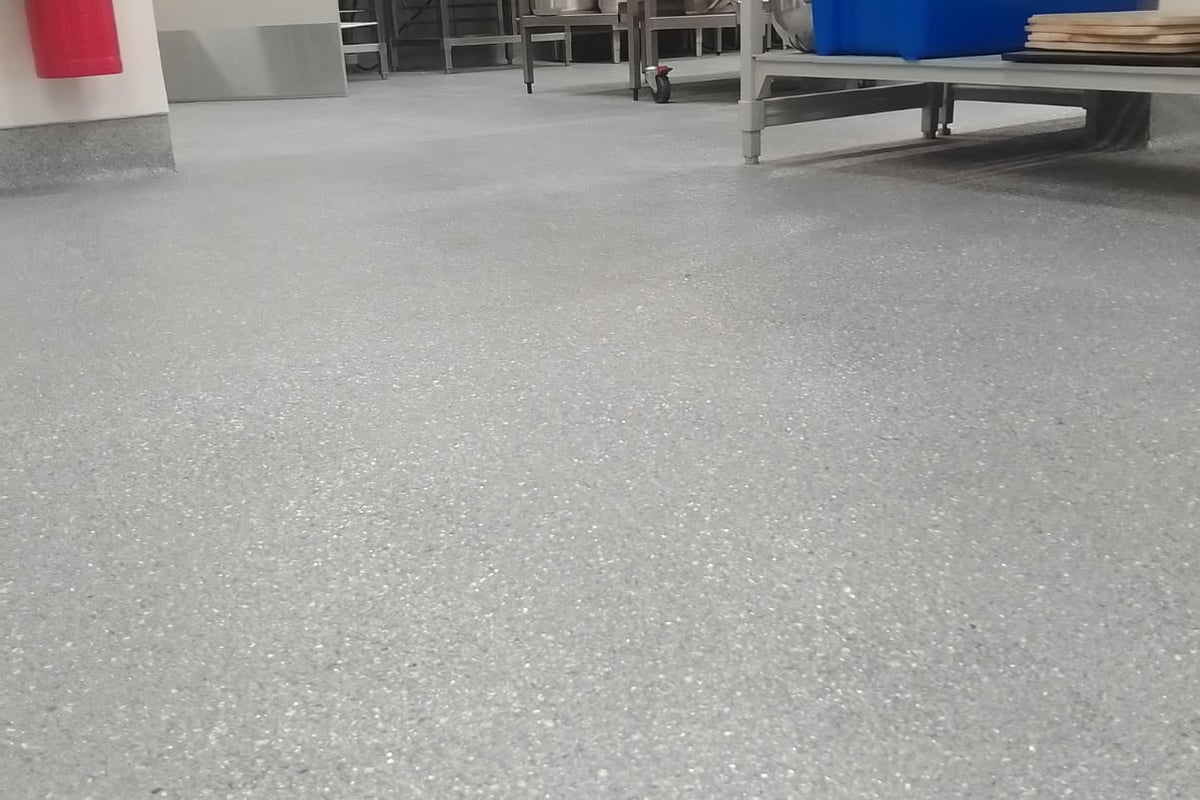
Food safety regulations dictate seamless, impervious flooring that prevents bacterial growth and facilitates thorough cleaning. Epoxy flooring systems for commercial kitchens incorporate antimicrobial additives and thermal shock resistance.
Health department inspections scrutinize floor-wall junctions, drain surrounds, and equipment bases. Professional contractors understand these compliance requirements, installing coved skirting and seamless transitions that satisfy regulatory standards.
| Industry | Primary Requirement | Common Challenges | Recommended System |
|---|---|---|---|
| Warehouse | Impact resistance | Forklift damage | Heavy-duty mortar |
| Manufacturing | Chemical resistance | Thermal cycling | Specialized epoxy |
| Retail | Aesthetics | Customer safety | Decorative graveled |
| Commercial kitchen | Hygiene | Thermal shock | Antimicrobial epoxy |
Retail and Showroom Spaces
Customer-facing environments balance durability with visual appeal. Retailers seeking commercial epoxy flooring near me often explore polished concrete flooring options alongside decorative epoxy systems.
Brand consistency, lighting reflectivity, and maintenance appearance influence system selection. High-traffic retail areas require durable coatings maintaining aesthetic appeal despite constant foot traffic.
Superior Concrete Finishes specializes in delivering high-performance epoxy flooring solutions tailored to commercial and industrial requirements. With decades of experience across warehouses, factories, commercial kitchens, and retail environments, our QBCC-licensed team understands the unique demands of South East Queensland facilities.
Cost Considerations and Project Budgeting
Commercial epoxy flooring investment extends beyond initial installation costs. Lifecycle analysis reveals that quality systems deliver superior value through reduced maintenance requirements and extended service life.
Initial cost factors include:
- Floor area and accessibility
- Substrate condition and preparation requirements
- System type and thickness specifications
- Colour and decorative elements
- Project timeline and after-hours requirements
Rushed installations typically cost more due to accelerated schedules requiring additional labour or specialized fast-cure systems. Planning installations during slower operational periods reduces costs and minimizes business disruption.
Long-Term Value Assessment
Quality epoxy flooring systems deliver 15-20 years of service life when properly maintained, compared to 3-5 years for inferior installations. This longevity significantly reduces lifecycle costs despite higher initial investment.
The comprehensive guide to commercial epoxy floor coatings demonstrates how proper maintenance extends system life and preserves performance. Regular cleaning protocols and periodic recoating maintain appearance and protective properties.
Calculating total cost of ownership:
- Initial installation investment
- Annual maintenance requirements
- Expected service life duration
- Replacement or recoating intervals
- Operational disruption costs during maintenance
Facilities management teams increasingly recognize that the cheapest initial quote rarely delivers best value. Experienced contractors providing detailed specifications, quality materials, and proven installation processes justify premium pricing through superior outcomes.
Maintenance Requirements and System Performance
Understanding maintenance obligations helps businesses evaluate the true cost of epoxy flooring systems. Professional contractors educate clients on proper care procedures maximizing system longevity.
Daily maintenance requirements remain minimal compared to alternative flooring options. Regular dust mopping and occasional damp mopping maintain appearance and performance in most commercial settings.
Establishing Maintenance Protocols
Daily procedures:
- Dust mopping or sweeping to remove abrasive particles
- Immediate spill cleanup preventing staining
- Spot cleaning traffic patterns and work areas
Weekly procedures:
- Damp mopping with pH-neutral cleaners
- Inspection for damage or wear patterns
- High-traffic area attention
Periodic procedures:
- Deep cleaning using auto-scrubbers
- Topcoat reapplication in heavy-use areas
- Professional assessment and minor repairs
The complete guide to epoxy floor maintenance emphasizes preventive care over reactive repairs. Establishing protocols during system installation ensures staff understand proper procedures.

Harsh chemical cleaners damage epoxy surfaces over time. Contractors should specify approved cleaning products and provide training on proper dilution ratios and application methods. Many system failures attributed to product defects actually result from improper maintenance practices.
Questions to Ask When Contacting Local Contractors
Effective contractor vetting requires asking specific technical questions beyond basic pricing inquiries. Responses reveal expertise levels and project approach methodologies.
Essential questions include:
- How many years have you specialized in commercial epoxy flooring?
- Can you provide references from similar industry projects?
- What surface preparation methods do you employ?
- How do you handle moisture issues in concrete substrates?
- What warranty coverage do you provide on materials and installation?
- Are you QBCC licensed and fully insured?
- How do you minimize operational disruption during installation?
- What maintenance protocols do you recommend?
Request detailed written quotations specifying system components, preparation procedures, application methods, and performance warranties. Vague quotations lacking technical specifications often indicate inexperienced contractors.
Site Assessment and Quotation Process
Professional contractors conduct thorough site assessments before providing accurate quotations. This investigation identifies substrate conditions, moisture levels, existing coating removal requirements, and access constraints.
Contractors offering instant quotes without site inspection risk underestimating project scope, leading to cost overruns or substandard installations. Quality assessments include:
- Concrete condition evaluation and core testing
- Moisture vapor emission rate testing
- Surface contamination assessment
- Traffic pattern and loading analysis
- Environmental condition review
Detailed assessments produce accurate specifications matching facility requirements. The in-depth guide to commercial epoxy flooring explains how proper evaluation prevents common installation failures.
The Installation Process and Timeline
Understanding installation phases helps businesses plan around flooring projects. Realistic timeline expectations prevent scheduling conflicts and operational disruptions.
Typical project phases:
- Preparation (40% of timeline): Surface grinding, crack repair, cleaning
- Primer application (10%): Base coat providing adhesion
- Epoxy application (30%): Main coating system installation
- Topcoat sealing (10%): Protective finish layer
- Curing period (10%): Chemical cure before use
A 500-square-meter warehouse typically requires 5-7 days from preparation to reopening, depending on system complexity and curing requirements. Accelerated schedules using rapid-cure systems compress timelines but increase material costs.
Managing Business Continuity During Installation
Professional contractors minimize operational disruption through strategic project phasing. Large facilities can often maintain partial operations while sections undergo coating application.
Disruption mitigation strategies:
- After-hours and weekend installation scheduling
- Sectional project phasing maintaining partial access
- Rapid-cure systems reducing downtime
- Temporary protection of adjacent operational areas
- Clear communication regarding access restrictions
Concrete flooring systems installations in 24-hour operations require careful coordination. Contractors experienced with operational facilities understand production schedules and develop installation plans accommodating business requirements.
Environmental and Safety Considerations
Modern epoxy systems address environmental concerns while maintaining performance standards. VOC regulations increasingly influence product selection, particularly for enclosed facilities.
Low-VOC and water-based epoxy options reduce odour and emissions during application. These systems prove particularly valuable for facilities maintaining operations during installation or those with stringent indoor air quality requirements.
Workplace Safety During and After Installation
Professional contractors implement comprehensive safety protocols protecting both installation crews and facility occupants. Proper ventilation, personal protective equipment, and access control prevent exposure incidents.
Post-installation safety features include:
- Slip-resistant additives in high-risk areas
- Chemical resistance preventing hazardous material absorption
- Easy-to-clean surfaces facilitating spill management
- Clear line marking for traffic control and hazard designation
The maintenance tips for epoxy flooring in commercial settings emphasize ongoing safety through proper care. Regular inspection identifies wear patterns or damage requiring attention before safety risks develop.
Technology and Innovation in Commercial Epoxy Systems
Epoxy technology continues evolving, offering enhanced performance characteristics and expanded application possibilities. Staying current with innovations helps businesses select optimal systems for specific requirements.
Recent advancements include:
- Fast-cure formulations reducing downtime to hours
- Enhanced UV resistance preventing yellowing in exposed areas
- Improved chemical resistance for aggressive environments
- Sustainable bio-based resins reducing environmental impact
- Antimicrobial additives for healthcare and food processing
Static-dissipative systems protect sensitive electronics in manufacturing facilities. Conductive systems provide earthing paths preventing electrostatic discharge damage. These specialized formulations require contractors with specific technical expertise and installation experience.
Colour and Aesthetic Options
Commercial epoxy flooring extends beyond industrial grey. Modern systems offer extensive colour ranges, decorative flake options, and metallic finishes creating distinctive appearances.
Epoxy flooring colours serve functional purposes beyond aesthetics. Colour coding designates work zones, traffic patterns, and safety areas. High-visibility colours improve workplace safety through clear spatial definition.
Retail environments increasingly specify decorative systems competing aesthetically with traditional flooring while maintaining superior durability. Metallic epoxy creates contemporary appearances attracting customer attention whilst withstanding heavy foot traffic.
Selecting the Right System for Your Facility
Matching epoxy systems to facility requirements demands understanding operational demands, environmental conditions, and performance priorities. Generic approaches rarely deliver optimal outcomes across diverse commercial applications.
System selection criteria:
| Factor | Considerations | Impact on Selection |
|---|---|---|
| Traffic type | Foot, forklift, vehicle | Thickness and composition |
| Chemical exposure | Specific contaminants | Resin formulation |
| Temperature range | Heat, cold, thermal shock | Specialized additives |
| Aesthetic requirements | Appearance standards | Decorative options |
| Maintenance capability | Staff, equipment, frequency | System complexity |
Consulting experienced contractors familiar with your industry provides valuable insights. Professional assessment identifies critical performance requirements and recommends systems proven in similar applications.
The commercial epoxy flooring business guide explores industry-specific considerations influencing system selection. Understanding these factors before contractor engagement facilitates productive discussions and accurate specifications.
Documentation and Warranty Considerations
Comprehensive documentation protects business investments and establishes clear performance expectations. Quality contractors provide detailed specifications, installation records, and maintenance guidelines.
Essential documentation includes:
- Material specifications and safety data sheets
- Surface preparation reports and moisture testing results
- Application records including cure times and conditions
- Maintenance protocols and approved cleaning products
- Warranty coverage terms and claim procedures
Performance warranties typically cover 5-10 years for materials and installation workmanship. Understanding warranty limitations prevents disputes. Most warranties exclude damage from improper maintenance, chemical exposure beyond specifications, or mechanical abuse.
Maintenance Records and System Longevity
Maintaining detailed cleaning and inspection records supports warranty claims and tracks system performance. These records help identify developing issues before major failures occur.
Professional facilities management includes scheduled inspections documenting:
- Surface condition and wear patterns
- Cleaning compliance and product usage
- Damage incidents and repair history
- Performance issues or changing requirements
Documentation demonstrates proper care when warranty claims arise. Simple maintenance tips implemented consistently prevent most common problems, protecting both system integrity and warranty coverage.
Selecting the right commercial epoxy flooring contractor requires careful evaluation of technical expertise, industry experience, and project management capabilities. When searching for commercial epoxy flooring near me, prioritize QBCC-licensed professionals with proven track records in facilities matching your operational requirements. Superior Concrete Finishes brings decades of commercial and industrial flooring experience to South East Queensland businesses, delivering durable, fit-for-purpose epoxy and polished concrete solutions backed by comprehensive warranties and ongoing support. Contact our team today to discuss how we can transform your facility with professional concrete flooring systems designed for Australian commercial environments.

Joshua Miller has over 15 years of experience in the commercial concrete flooring industry, specialising in epoxy flooring systems and polished concrete solutions for warehouses, factories, retail spaces and commercial developments. Joshua and his team work closely with builders, property owners and facility managers across South East Queensland to deliver durable, cost-effective commercial flooring systems for warehouses, industrial facilities, commercial kitchens, retail stores and large commercial developments.
Major builders and organisations Josh has led projects on include McNab, Hutchinson Builders, IKEA, Queensland Rail, University of Queensland, ADCO, Tomkins Commercial, Bunnings, OfficeWorks, Spotlight, and Anaconda.
If you're planning a project and need advice on the best commercial concrete flooring solution, contact Josh or one of the team at Superior Concrete Finishes.
-
 info@superiorconcretefinishes.com.au
-
1300 789 740
-
Connect with Josh on
LinkedIn


 Connect with Josh on