
Selecting the right contractor for your commercial flooring project can significantly impact both immediate results and long-term performance. Concrete polishing companies vary widely in their capabilities, equipment, and expertise, making the selection process crucial for facility managers, property developers, and business owners. With the commercial flooring industry experiencing substantial growth across South East Queensland and throughout Australia, understanding what distinguishes exceptional contractors from mediocre ones has never been more important. This guide examines the critical factors that separate professional concrete polishing companies from those that simply own equipment, providing you with the knowledge to make informed decisions for your warehouse, retail store, factory, or commercial facility.
Understanding the Commercial Concrete Polishing Industry
The concrete polishing sector has evolved dramatically over the past decade, transitioning from a niche service to a mainstream flooring solution for commercial and industrial applications. Professional concrete polishing companies now serve diverse markets, including retail environments, manufacturing facilities, logistics centres, and commercial carparks.
Market Landscape and Specialisation
Not all concrete polishing companies operate with the same focus or capabilities. Some contractors serve primarily residential clients, whilst others specialise exclusively in commercial and industrial projects. This distinction matters considerably when evaluating potential contractors for your facility.
Commercial-focused contractors bring specific advantages:
- Equipment scaled for large projects: Industrial-grade grinding machines designed for extensive square metreage
- Understanding of operational constraints: Experience working around business hours and production schedules
- Compliance knowledge: Familiarity with workplace health and safety regulations, building codes, and industry standards
- Project management capabilities: Systems for handling multi-stage projects with minimal disruption
The benefits and limitations of polished concrete become particularly relevant in commercial settings, where durability, maintenance requirements, and lifecycle costs drive decision-making. Companies that understand these factors can provide realistic assessments of whether polishing suits your specific application.
Service Differentiation in the Market
Concrete polishing companies typically fall into several categories based on their service range and expertise. Some contractors offer polishing as one of many general contracting services, whilst specialists dedicate their entire operation to concrete surface treatments.
| Contractor Type | Typical Characteristics | Best Suited For |
|---|---|---|
| Specialist Polishing Companies | Dedicated equipment, trained crews, extensive polishing portfolio | Large commercial projects requiring precision |
| Full-Service Concrete Contractors | Broad capabilities including placement and finishing | New construction with integrated concrete work |
| Multi-Trade Flooring Contractors | Various flooring types with polishing as one option | Projects requiring multiple flooring solutions |
| Industrial Coating Specialists | Polishing plus epoxy and other protective systems | Facilities needing both polished and coated areas |
Critical Qualifications and Credentials
Professional concrete polishing companies demonstrate their legitimacy through specific licences, insurance coverage, and industry affiliations. These credentials provide protection for your business and indicate a contractor's commitment to professional standards.
Licensing Requirements
In Queensland, concrete polishing falls under specific trade licensing requirements. Legitimate contractors hold a QBCC (Queensland Building and Construction Commission) licence appropriate for their scope of work. This licensing ensures contractors meet minimum standards for technical competence, financial viability, and insurance coverage.
When evaluating concrete polishing companies, verify:
- Current QBCC licence number and status
- Licence class appropriate for commercial work
- Any conditions or restrictions on the licence
- History of complaints or disciplinary actions
- Financial standing and company stability
Insurance and Risk Management
Comprehensive insurance coverage separates professional concrete polishing companies from inadequately protected contractors. Commercial projects require substantial coverage across multiple areas.
Essential insurance policies include:
- Public liability insurance (minimum $20 million recommended for commercial work)
- Workers compensation insurance for all employees
- Professional indemnity coverage
- Contract works insurance for larger projects
The absence of appropriate insurance transfers significant risk to your business. If an uninsured contractor causes property damage or if a worker is injured on your premises, your organisation may face substantial liability exposure.
Technical Capabilities and Equipment Standards
The concrete polishing process requires sophisticated equipment and technical knowledge. Professional concrete polishing companies invest significantly in industrial-grade machinery, tooling, and ongoing training for their crews.
Equipment Quality and Maintenance
Industrial concrete polishing demands purpose-built equipment capable of handling large areas efficiently whilst maintaining consistent results. Professional contractors operate planetary grinding machines, dust extraction systems, and specialised tooling that represents considerable capital investment.
Quality indicators in equipment include:
- Machine capacity: Planetary grinders sized appropriately for commercial square metreage
- Dust control systems: HEPA-filtered vacuum systems meeting workplace air quality standards
- Tooling inventory: Complete progression of diamond tooling from coarse grinding through final polishing
- Backup equipment: Redundant machines ensuring project timelines remain intact despite mechanical issues
Well-maintained equipment produces superior results and indicates a contractor's professionalism. Companies that prioritise equipment upkeep demonstrate attention to quality throughout their operations.
Technical Process Understanding
Professional concrete polishing companies understand the science behind the process, not just the mechanical steps. This knowledge enables them to assess concrete conditions, recommend appropriate treatment levels, and troubleshoot issues that arise during execution.
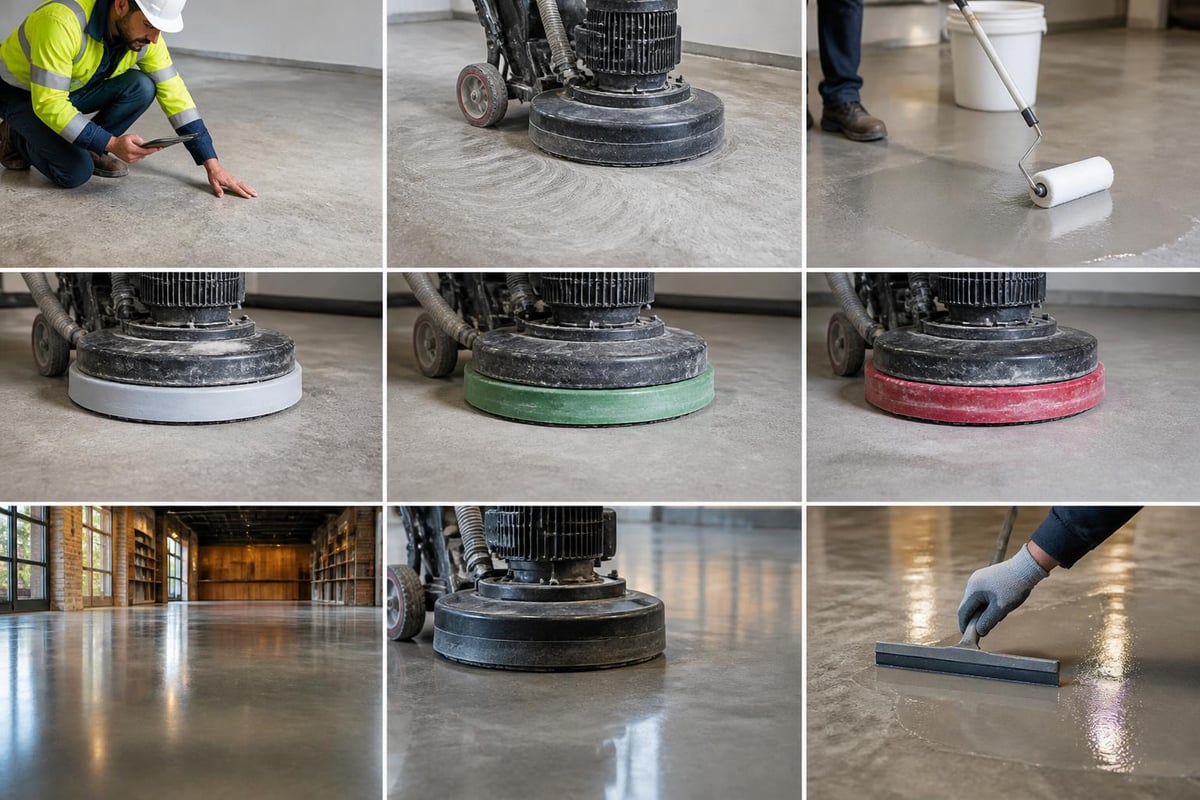
Polished concrete involves multiple grinding stages, densification treatments, and progressive polishing to achieve specified gloss levels. The ability to evaluate concrete hardness, predict aggregate exposure, and adjust techniques based on slab conditions distinguishes experienced contractors from those following rote procedures.

Project Experience and Portfolio Assessment
Past performance provides the most reliable indicator of a contractor's capabilities. When evaluating concrete polishing companies, examine their portfolio for projects similar in scope, application, and complexity to your requirements.
Relevant Commercial Experience
Experience in your specific facility type matters considerably. A contractor with extensive warehouse flooring experience brings understanding of load-bearing requirements, traffic patterns, and maintenance protocols specific to logistics operations. Similarly, companies familiar with retail flooring understand aesthetic requirements, installation timelines around trading hours, and customer safety considerations.
Request portfolio examples demonstrating:
- Comparable project sizes and complexity
- Similar facility types and operational environments
- Variety of finish levels and aesthetic outcomes
- Multi-phase projects with staging requirements
- Challenging conditions successfully addressed
References and Performance Verification
Reputable concrete polishing companies readily provide references from previous commercial clients. Speaking directly with facility managers or property owners who have engaged a contractor reveals insights unavailable through marketing materials.
Key questions for references include:
- Did the project complete on schedule and within budget?
- How did the contractor handle unexpected challenges or changes?
- What was the quality of communication throughout the project?
- How has the floor performed since installation?
- Would you engage this contractor for future projects?
Cost Structures and Value Assessment
Understanding concrete polishing costs requires examining multiple factors beyond simple per-square-metre pricing. Professional concrete polishing companies provide detailed quotations that account for project-specific conditions and requirements.
Pricing Factors and Variables
Legitimate contractors assess numerous variables when developing project pricing. Surface preparation requirements, existing concrete condition, desired finish level, and project accessibility all influence costs significantly.
| Cost Factor | Impact on Pricing | Typical Range |
|---|---|---|
| Surface preparation | Removal of coatings, repairs, levelling | 15-35% of total |
| Grinding and polishing | Labour, equipment, tooling consumption | 40-55% of total |
| Densification and sealing | Materials and application | 10-20% of total |
| Project management | Coordination, documentation, staging | 8-15% of total |
The complete price breakdown varies based on finish specifications, with higher gloss levels requiring additional polishing stages and finer tooling progressions. Professional contractors explain these variations rather than simply providing a single number.
Value Beyond Initial Cost
Evaluating concrete polishing companies based solely on lowest price often leads to disappointing outcomes. Professional contractors deliver value through superior workmanship, appropriate materials, and reliable warranties.
Consider the total cost of ownership:
- Longevity: Properly executed polishing extends floor life significantly
- Maintenance costs: Quality finishes require less frequent maintenance and refinishing
- Operational impact: Efficient contractors minimise business disruption
- Performance guarantees: Warranties protect against premature failure or defects
Quality Systems and Project Management
Professional concrete polishing companies implement documented systems for quality control, safety management, and project coordination. These systems ensure consistent outcomes regardless of crew or project specifics.
Safety Standards and Compliance
Commercial polishing projects involve dust generation, chemical application, and operation of heavy equipment. Contractors must maintain rigorous safety protocols protecting both their workers and your facility occupants.
Professional companies demonstrate safety commitment through:
- Documented safety management systems
- Regular toolbox meetings and hazard assessments
- Proper personal protective equipment for all crew members
- Compliance with workplace safety standards
- Dust control measures exceeding minimum requirements
Communication and Documentation
Clear communication distinguishes professional concrete polishing companies from contractors who leave clients guessing about project status, timelines, or issues. Established communication protocols ensure all stakeholders remain informed throughout the project lifecycle.
Effective contractors provide:
- Pre-project documentation: Detailed scope of work, specifications, timelines
- Progress updates: Regular reporting on completed stages and upcoming work
- Issue resolution: Prompt notification and collaborative problem-solving for unexpected conditions
- Completion documentation: As-built records, maintenance guidelines, warranty information
- Post-project support: Responsive service for questions or concerns after handover
Specialist Knowledge and Problem-Solving Capabilities
The ability to assess concrete conditions, predict potential issues, and implement effective solutions separates experienced concrete polishing companies from those with limited expertise. Commercial facilities often present challenging conditions requiring adaptive approaches.
Concrete Assessment and Remediation
Professional contractors conduct thorough concrete assessment before committing to specific approaches or outcomes. This evaluation identifies factors affecting polishing success, including concrete hardness, moisture content, previous treatments, and structural integrity.
Common challenges requiring specialist knowledge:
- Contaminated concrete: Oil stains, chemical exposure, or previous coating residues
- Moisture issues: Hydrostatic pressure or elevated relative humidity
- Surface damage: Spalling, cracking, or joint deterioration
- Inconsistent concrete: Variable hardness or aggregate distribution
- Colour variations: Managing expectations around natural concrete appearance
Companies with extensive experience across commercial warehouse flooring and factory flooring projects have encountered diverse conditions and developed solutions for complex situations.
Alternative Recommendations
Honest concrete polishing companies recognise when polishing may not suit specific applications. Rather than forcing inappropriate solutions, professional contractors recommend alternatives when conditions or requirements make polishing suboptimal.
In some commercial environments, epoxy flooring systems provide superior performance for chemical resistance, hygiene requirements, or specific operational needs. Contractors who offer multiple flooring solutions can objectively assess which approach best serves your facility's requirements.
Environmental Considerations and Sustainability
Modern commercial property management increasingly prioritises environmental performance and sustainability credentials. Professional concrete polishing companies understand these requirements and can demonstrate how their processes and outcomes support environmental objectives.
Sustainable Flooring Attributes
Polished concrete delivers inherent environmental benefits compared to many alternative flooring systems. The process utilises existing concrete slabs rather than requiring additional materials, reducing embodied carbon and resource consumption.
Environmental advantages include:
- Minimal material consumption beyond densifiers and sealers
- No off-gassing from adhesives or volatile organic compounds
- Enhanced thermal mass supporting passive temperature regulation
- Longevity reducing replacement cycles and associated environmental impact
- Reflectivity improving natural light distribution and reducing artificial lighting requirements
Companies familiar with green building standards can document these benefits for sustainability reporting or building certification programmes.
Dust Management and Indoor Air Quality
The concrete grinding process generates significant dust without proper control measures. Professional concrete polishing companies prioritise dust containment through industrial vacuum systems and work practices that maintain indoor air quality during installation.
HEPA filtration systems capture particulates preventing circulation through HVAC systems or settlement on equipment and inventory. This attention to air quality protects both worker health and facility operations, particularly critical in occupied facilities or staged projects.
Regional Expertise and Local Knowledge
Concrete polishing companies operating within specific regions develop understanding of local conditions, building practices, and concrete characteristics. This regional knowledge influences project approaches and outcome expectations.
South East Queensland Considerations
Contractors experienced in South East Queensland understand regional factors affecting concrete polishing success. Climate conditions, common concrete mixes, and local building practices create specific considerations for commercial polishing projects.
Regional factors include:
- Humidity levels affecting curing times and moisture testing requirements
- Concrete aggregate types common to Queensland quarries and their polishing characteristics
- Building standards and inspection protocols specific to Queensland regulations
- Seasonal considerations for scheduling and project planning
- Local supplier networks for specialised materials and equipment support
Market Understanding and Industry Connections
Established concrete polishing companies develop networks within their regional markets, including relationships with concrete suppliers, testing laboratories, and complementary trades. These connections enable efficient problem-solving and access to specialist resources when projects demand them.
Professional contractors also understand local market dynamics, competitive pricing, and realistic timelines based on regional demand and contractor availability. This knowledge ensures quotations reflect current market conditions rather than outdated assumptions.
Making the Selection Decision
After evaluating multiple concrete polishing companies against the criteria outlined above, compile your findings into a structured comparison supporting informed decision-making.
Evaluation Framework
Create a scoring system weighting factors based on your project priorities. A large warehouse project might prioritise experience and equipment capacity, whilst a retail installation emphasises aesthetic outcomes and scheduling flexibility.
| Evaluation Criteria | Weight | Contractor A | Contractor B | Contractor C |
|---|---|---|---|---|
| Relevant Experience | 25% | Score | Score | Score |
| Technical Capability | 20% | Score | Score | Score |
| Safety & Compliance | 15% | Score | Score | Score |
| Communication | 15% | Score | Score | Score |
| Value Proposition | 15% | Score | Score | Score |
| References | 10% | Score | Score | Score |
This systematic approach reduces bias and ensures all critical factors receive appropriate consideration in your selection process.
Red Flags and Warning Signs
Certain indicators suggest contractors may lack professionalism or capability necessary for successful commercial projects. Recognising these warning signs helps avoid problematic engagements.
Watch for:
- Reluctance to provide detailed quotations or specifications
- Inability to produce current insurance certificates or licence verification
- Limited or no commercial project portfolio
- Pressure tactics or unusually aggressive sales approaches
- Significantly lower pricing without clear explanation of differences
- Poor communication or unresponsiveness during quotation phase
Professional concrete polishing companies welcome detailed questions, provide transparent information, and demonstrate patience during your evaluation process. Contractors displaying opposite behaviours often create problems during project execution.
Selecting qualified concrete polishing companies requires careful evaluation of credentials, experience, and capabilities specific to commercial applications. The right contractor brings technical expertise, appropriate equipment, and professional systems ensuring your project delivers lasting value. Superior Concrete Finishes specialises in commercial and industrial concrete flooring throughout South East Queensland, offering both polished concrete and epoxy flooring solutions backed by decades of industry experience and full QBCC licensing. Contact Superior Concrete Finishes to discuss your facility's flooring requirements with experienced professionals who understand the unique demands of warehouses, retail stores, factories, and commercial facilities.

Joshua Miller has over 15 years of experience in the commercial concrete flooring industry, specialising in epoxy flooring systems and polished concrete solutions for warehouses, factories, retail spaces and commercial developments. Joshua and his team work closely with builders, property owners and facility managers across South East Queensland to deliver durable, cost-effective commercial flooring systems for warehouses, industrial facilities, commercial kitchens, retail stores and large commercial developments.
Major builders and organisations Josh has led projects on include McNab, Hutchinson Builders, IKEA, Queensland Rail, University of Queensland, ADCO, Tomkins Commercial, Bunnings, OfficeWorks, Spotlight, and Anaconda.
If you're planning a project and need advice on the best commercial concrete flooring solution, contact Josh or one of the team at Superior Concrete Finishes.
-
 info@superiorconcretefinishes.com.au
-
1300 789 740
-
Connect with Josh on
LinkedIn


 Connect with Josh on