Concrete floors in commercial and industrial environments face relentless challenges. From heavy forklift traffic in warehouses to chemical exposure in manufacturing facilities, these surfaces demand exceptional durability and protection. Concrete sealing provides a critical defence mechanism that extends floor lifespan, reduces maintenance costs, and enhances performance across diverse commercial applications. Understanding the technical aspects, benefits, and proper implementation of sealing systems enables facility managers and business owners to make informed decisions about protecting their concrete investments.
Understanding Concrete Sealing Fundamentals
Concrete is inherently porous, containing microscopic capillaries and air pockets throughout its structure. These voids allow moisture, chemicals, oils, and contaminants to penetrate the surface, leading to degradation over time. Concrete sealing addresses this vulnerability by creating a protective barrier that prevents infiltration whilst enhancing the floor’s functional properties.
The American Concrete Institute provides comprehensive standards for sealer selection and application, recognising that proper sealing practices significantly impact concrete longevity. In commercial settings, unsealed concrete gradually deteriorates through cycles of moisture absorption, freeze-thaw damage in cooler climates, chemical attack, and abrasion from daily operations.
The Science Behind Sealing Technology
Modern concrete sealers function through two primary mechanisms:
- Penetrating sealers that chemically react with concrete compounds to densify the surface matrix
- Topical sealers that form a physical film layer over the concrete surface
- Reactive sealers that fill capillary pores through crystalline growth
- Barrier sealers that sit atop the surface to block contaminant entry
Each category offers distinct advantages depending on the operational requirements of the facility. Research on C-S-H gel production demonstrates innovative approaches to repairing and sealing cementitious materials at the molecular level, pointing toward future advancements in sealing technology.

Types of Commercial Concrete Sealers
Selecting the appropriate sealer requires understanding the operational demands of your specific commercial environment. Different formulations provide varying levels of protection, aesthetics, and performance characteristics.
Penetrating Silicate Sealers
Silicate-based densifiers penetrate deeply into concrete, reacting with calcium hydroxide to form calcium silicate hydrate. This reaction permanently densifies the concrete matrix, increasing surface hardness and reducing porosity.
| Feature | Performance Rating | Best Application |
|---|---|---|
| Durability | Excellent | High-traffic warehouses |
| Chemical Resistance | Good | Light industrial |
| Moisture Blocking | Moderate | Interior applications |
| Surface Enhancement | Natural finish | Polished concrete prep |
These sealers work exceptionally well as a foundation treatment before applying polished concrete flooring, as they harden the surface and reduce dusting.
Acrylic and Polyurethane Topical Sealers
Topical sealers create a protective film over the concrete surface, offering aesthetic enhancement alongside functional protection. Acrylic sealers provide economical protection with moderate durability, whilst polyurethane formulations deliver superior chemical and abrasion resistance.
For commercial kitchens and food processing facilities, polyurethane sealers offer excellent resistance to oils, acids, and cleaning chemicals. However, topical sealers require periodic reapplication as the film layer wears through normal use.
Epoxy-Based Sealing Systems
Whilst complete epoxy flooring systems provide comprehensive protection, thin epoxy sealers offer an intermediate solution. These two-part systems bond directly to concrete, creating an impervious barrier against moisture and chemical penetration.
The epoxy flooring systems commonly used in warehouses and factories represent the ultimate evolution of concrete sealing, combining surface protection with enhanced durability and aesthetic options.

Benefits of Professional Concrete Sealing
Implementing a proper sealing programme delivers measurable returns across operational, financial, and safety metrics. Commercial facilities that invest in quality sealing systems experience tangible benefits that justify the initial expense.
Extended Service Life and Reduced Maintenance
Sealed concrete lasts significantly longer than unsealed surfaces in commercial environments. The protective barrier prevents deterioration mechanisms from taking hold, postponing expensive repairs or replacement.
According to VanDerVart Concrete Products, proper concrete maintenance including sealing can extend service life by decades compared to neglected surfaces. For warehouse operations managing tight budgets, this translates to deferred capital expenses and improved asset value.
Maintenance requirements decrease substantially with sealed floors:
- Reduced dust generation minimises cleaning frequency
- Stain resistance prevents permanent discolouration
- Simplified cleaning protocols lower labour costs
- Decreased wear rates extend time between refinishing
Chemical and Moisture Protection
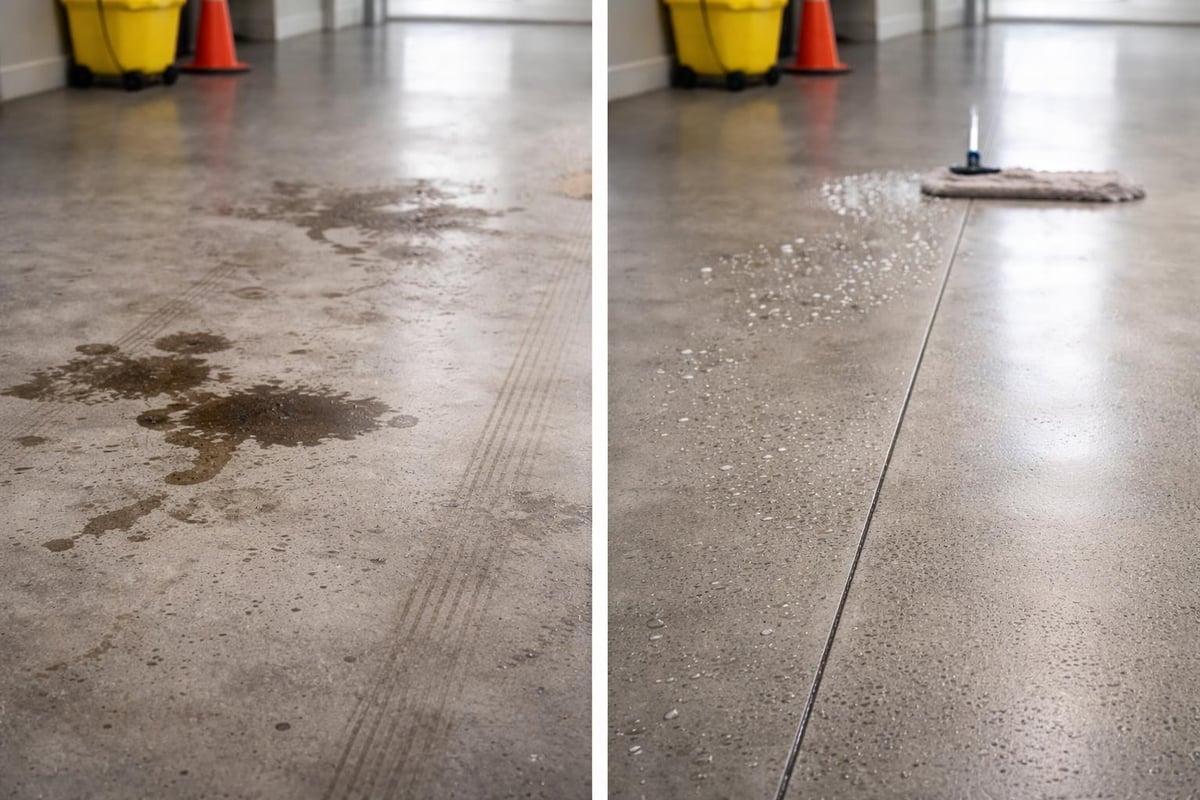
Industrial and commercial facilities regularly encounter aggressive substances that attack unsealed concrete. Hydraulic fluids in factory flooring applications, cleaning chemicals in retail environments, and petroleum products in automotive workshops all threaten concrete integrity.
Concrete sealing provides essential chemical resistance, preventing these substances from penetrating and weakening the concrete matrix. Moisture protection proves equally critical, particularly in areas exposed to regular wet conditions or groundwater infiltration.
The National Academies Press documents the importance of joint sealant practices in preventing water infiltration, which applies equally to surface sealing in commercial applications.
Application Methodology for Commercial Spaces
Professional concrete sealing demands meticulous surface preparation and precise application techniques. The quality of the finished result depends heavily on proper execution of each stage in the process.
Surface Preparation Requirements
Adequate preparation determines sealer performance more than any other factor. Commercial concrete must meet specific criteria before sealer application:
- Cleanliness: Remove all contaminants, oils, existing coatings, and loose material
- Moisture content: Test and verify concrete moisture levels are within acceptable limits
- Surface profile: Ensure appropriate texture for sealer adhesion
- Repairs: Complete all crack repairs, joint filling, and structural corrections
For new concrete installations, timing becomes critical. According to curing practices documentation, concrete must cure adequately before sealer application to prevent moisture entrapment and adhesion failures.
Professional preparation typically involves diamond grinding or shot blasting to open the concrete pores and create a receptive surface profile. This mechanical preparation also removes any laitance or weak surface material that could compromise sealer bonding.
Application Techniques and Best Practices
Different sealer types require specific application methods to achieve optimal results. Penetrating sealers generally apply more simply than reactive topical systems, but each demands attention to detail.
| Sealer Type | Application Method | Coverage Rate | Recoat Time |
|---|---|---|---|
| Silicate Densifier | Spray or mop | 150-300 m²/L | Single coat |
| Acrylic Sealer | Spray or roller | 5-10 m²/L | 2-4 hours |
| Polyurethane | Roller or squeegee | 4-8 m²/L | 12-24 hours |
| Epoxy Sealer | Roller or squeegee | 3-6 m²/L | 24 hours |
Temperature and humidity conditions during application significantly impact curing and film formation. Most sealers perform optimally when applied between 10°C and 30°C with relative humidity below 85%. South East Queensland’s climate generally provides favourable conditions for sealing work, though summer humidity may require scheduling adjustments.
Professional applicators use sophisticated equipment to ensure uniform coverage. Airless sprayers deliver consistent film thickness for topical sealers, whilst microfiber applicators work well for penetrating densifiers that require thorough surface saturation.
Sealing Requirements by Facility Type
Commercial and industrial environments present unique challenges that influence sealer selection and application strategies. Understanding these specific requirements ensures optimal protection for each application.
Warehouse and Distribution Centres
Warehouse flooring endures constant forklift traffic, pallet impacts, and goods storage. These facilities benefit most from penetrating densifiers combined with periodic topical sealing.
The densification process hardens the concrete surface, increasing its resistance to abrasion from steel wheels and pallet jacks. Following densification, a sacrificial topical sealer protects against staining from spills and simplifies maintenance.
High-traffic zones near loading docks and main throughways may require more robust protection. Many warehouses transition to complete epoxy systems in these critical areas whilst maintaining sealed concrete throughout the broader facility.
Retail and Commercial Spaces
Retail flooring applications prioritise aesthetics alongside protection. Polished concrete with penetrating sealers creates attractive, low-maintenance surfaces that enhance the shopping experience.
The American Society of Concrete Contractors provides technical guidance on sealing decorative concrete, emphasising the importance of sealer selection in maintaining visual appeal. Retail environments benefit from sealers that enhance concrete’s natural colour without creating slippery surfaces or noticeable film buildup.
Manufacturing and Industrial Facilities
Chemical exposure in manufacturing environments demands specialised sealing solutions. Brewery flooring and food processing areas require sealers that resist organic acids, caustic cleaning agents, and thermal cycling from washdown procedures.
Multi-layer sealing systems often provide the best solution:
- Initial penetrating sealer to densify and stabilise the substrate
- Chemical-resistant primer to bridge the concrete and topcoat
- Polyurethane or epoxy topcoat for chemical and abrasion resistance
- Periodic maintenance coats to refresh protection
Maintenance and Longevity Considerations
Even the highest-quality sealing systems require ongoing maintenance to sustain their protective properties. Developing a structured maintenance programme maximises return on investment and extends the service life of sealed concrete floors.
Regular Maintenance Protocols
Daily cleaning removes abrasive particles that gradually wear the sealer surface. Dust mopping or auto-scrubbing with neutral pH cleaners prevents buildup without degrading the sealer chemistry.
Quarterly inspections identify areas experiencing accelerated wear, allowing targeted resealing before widespread deterioration occurs. High-traffic zones typically require more frequent attention than low-use areas.
Guidance from Cemstone on concrete sealing emphasises that protecting your investment requires both initial quality application and ongoing care. Commercial facilities should budget for periodic resealing based on traffic levels and exposure conditions.
Resealing Schedules and Indicators
Determining when to reseal depends on multiple factors:
- Traffic intensity: Heavy forklift use accelerates wear compared to foot traffic
- Chemical exposure: Regular spills degrade sealers faster than dry environments
- Cleaning practices: Aggressive cleaning chemicals reduce sealer longevity
- Initial sealer type: Topical films wear through use; penetrating sealers last longer
Visual indicators signal the need for resealing. Watch for increased dust generation, visible staining that resists cleaning, water absorption rather than beading, and dull or worn appearance in traffic patterns.
Most commercial facilities require topical sealer renewal every 2-5 years, whilst penetrating densifiers may last 10-15 years or longer. The Federal Highway Administration’s preservation checklist for concrete pavements includes joint sealing guidelines that translate well to commercial floor maintenance.
Economic Analysis of Sealing Investments
Financial decision-makers require clear justification for concrete sealing expenditure. Analysing costs versus benefits demonstrates the economic wisdom of proper floor protection.
Initial Investment Versus Lifecycle Costs
Sealing represents a relatively modest investment compared to total floor replacement or extensive repairs. For a 1,000 square metre warehouse, professional sealing costs typically range from $3-15 per square metre depending on the sealer type and surface condition.
Compare this to replacement costs exceeding $100 per square metre for new concrete installation, or $40-80 per square metre for complete floor restoration. The economic case for preventive sealing becomes compelling when viewed through a lifecycle cost lens.
Return on investment materialises through multiple channels:
- Extended replacement cycle postpones major capital expenditure
- Reduced cleaning costs from easier maintenance
- Decreased downtime from floor repairs
- Enhanced property value from well-maintained facilities
- Improved safety from dust reduction and better traction
Calculating Total Cost of Ownership
Sophisticated facility managers calculate total cost of ownership across the expected service life. This analysis includes initial sealing costs, periodic resealing expenses, routine maintenance, and eventual replacement at end of life.
| Scenario | 10-Year Cost | 20-Year Cost | Floor Lifespan |
|---|---|---|---|
| Unsealed Concrete | $45,000 | $125,000 | 15-20 years |
| Basic Sealing | $28,000 | $62,000 | 25-30 years |
| Premium Sealing | $35,000 | $71,000 | 30-40 years |
These figures assume a 1,000 m² facility with moderate traffic. The analysis clearly demonstrates that sealed concrete delivers lower total ownership costs despite higher initial investment.
Environmental and Safety Considerations
Modern commercial operations increasingly prioritise sustainability and worker safety. Concrete sealing contributes positively to both objectives when implemented with appropriate product selection and application practices.
Sustainability Benefits
Sealed concrete supports environmental goals through enhanced durability and resource conservation. Extending floor lifespan reduces the environmental impact associated with concrete replacement, including raw material extraction, manufacturing emissions, and disposal of demolished materials.
Many contemporary sealers feature low VOC formulations that minimise air quality impacts during application and throughout the floor’s service life. Water-based acrylics and silicate densifiers produce minimal odours and emissions compared to older solvent-based products.
The improved cleanability of sealed surfaces also reduces water and chemical consumption during routine maintenance, contributing to overall facility sustainability metrics.
Workplace Safety Enhancement
Concrete sealing improves workplace safety through multiple mechanisms. Dust suppression proves particularly valuable in distribution centres and manufacturing facilities where airborne particulates create respiratory hazards and visibility concerns.
Properly sealed floors maintain consistent traction characteristics, reducing slip hazards from dust accumulation or moisture exposure. Some sealers incorporate anti-slip additives or texture to further enhance grip in wet environments.
For businesses exploring their flooring options across various commercial applications, understanding how sealing integrates with overall floor system design helps optimise both performance and protection. The Superior Concrete Finishes portfolio demonstrates various sealing and coating applications across commercial and industrial settings.
Selecting Professional Sealing Services
The complexity of commercial concrete sealing demands professional expertise and proper licensing. Facility managers should evaluate potential contractors carefully to ensure quality outcomes that protect their floor investments.
Qualifications and Credentials
Reputable commercial flooring contractors hold appropriate licensing and insurance. In Queensland, proper QBCC licensing ensures contractors meet industry standards and maintain financial accountability. Comprehensive insurance coverage protects clients from liability during application work.
Experience in commercial and industrial applications proves essential. Contractors familiar with warehouse operations, retail requirements, and manufacturing environments understand the unique demands these facilities place on flooring systems.
Evaluating Contractor Proposals
Quality proposals demonstrate thorough site assessment and detailed specifications:
- Comprehensive surface evaluation including moisture testing
- Specific sealer product recommendations with technical justification
- Detailed surface preparation procedures
- Application methodology and coverage rates
- Realistic timeline accounting for curing and operational disruptions
- Maintenance recommendations and warranty terms
Beware of unusually low quotes that may indicate shortcuts in preparation or inferior products. The substantial difference in long-term performance justifies paying for quality materials and proper application.
Protecting commercial concrete floors through professional sealing delivers measurable benefits across operational efficiency, lifecycle costs, and facility appearance. The investment in quality sealing systems pays dividends through extended floor life, reduced maintenance requirements, and enhanced performance in demanding commercial environments. If you’re managing warehouses, retail stores, factories, or other commercial facilities across South East Queensland and need expert guidance on concrete floor protection, Superior Concrete Finishes brings decades of specialised experience in commercial and industrial flooring solutions, backed by full QBCC licensing and comprehensive insurance coverage.

Joshua Miller has over 15 years of experience in the commercial concrete flooring industry, specialising in epoxy flooring systems and polished concrete solutions for warehouses, factories, retail spaces and commercial developments. Joshua and his team work closely with builders, property owners and facility managers across South East Queensland to deliver durable, cost-effective commercial flooring systems for warehouses, industrial facilities, commercial kitchens, retail stores and large commercial developments.
Major builders and organisations Josh has led projects on include McNab, Hutchinson Builders, IKEA, Queensland Rail, University of Queensland, ADCO, Tomkins Commercial, Bunnings, OfficeWorks, Spotlight, and Anaconda.
If you're planning a project and need advice on the best commercial concrete flooring solution, contact Josh or one of the team at Superior Concrete Finishes.
-
 info@superiorconcretefinishes.com.au
-
1300 789 740
-
Connect with Josh on
LinkedIn


 Connect with Josh on