When you’re investing in commercial flooring for your warehouse, factory, or retail space, understanding epoxy floor durability isn’t just about selecting a surface-it’s about choosing a long-term solution that protects your concrete substrate and withstands the daily demands of your operation. The durability characteristics of epoxy flooring determine whether your floor will perform reliably for years or require costly repairs within months. For commercial and industrial facilities across South East Queensland, knowing what influences epoxy floor durability helps you make informed decisions that align with your operational requirements and budget constraints.
What Defines Epoxy Floor Durability in Commercial Settings
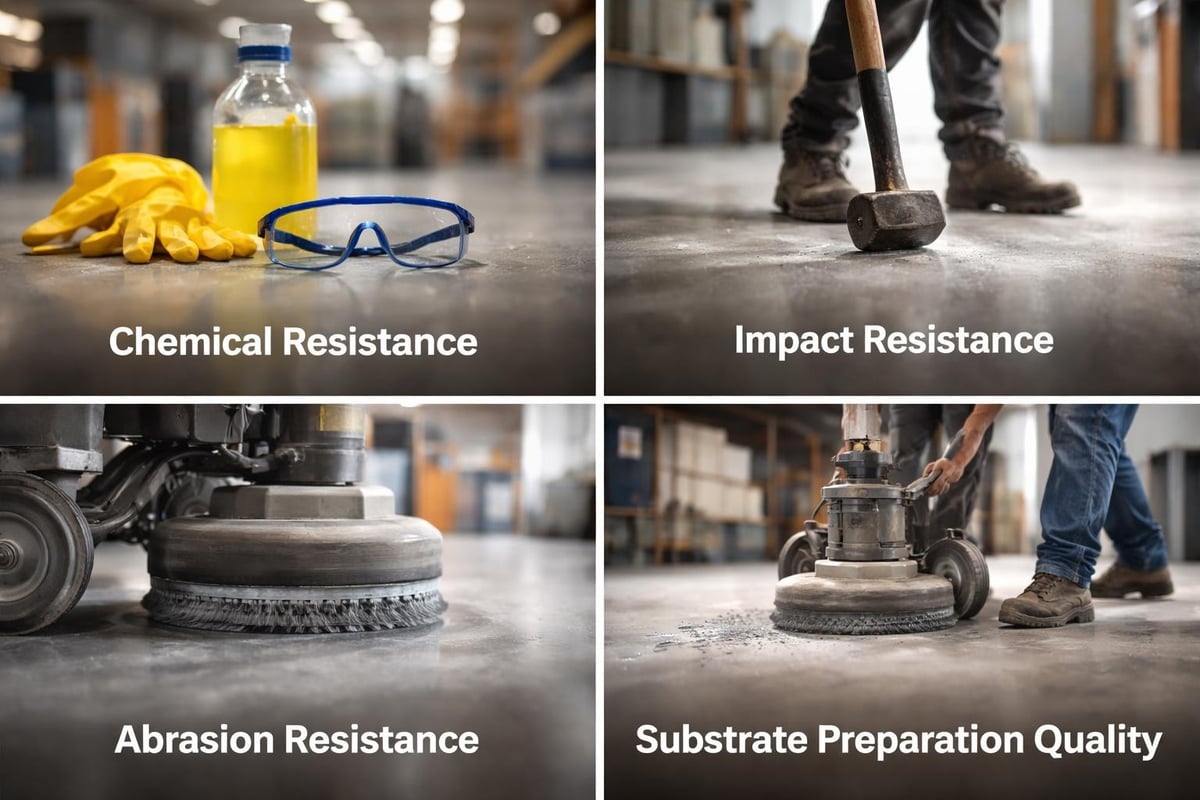
Epoxy floor durability encompasses multiple performance characteristics that work together to create a resilient flooring system. Chemical resistance stands as one of the most critical factors, particularly in manufacturing facilities and commercial kitchens where spills are inevitable. A properly formulated epoxy system creates a chemical barrier that prevents acids, alkalis, solvents, and oils from penetrating the surface and damaging the concrete substrate beneath.
Impact resistance determines how well your floor withstands dropped tools, equipment movements, and heavy loads. Industrial environments demand flooring that won’t crack or chip when forklifts operate continuously or when heavy components accidentally fall during production processes.
The abrasion resistance of epoxy flooring directly affects how long the surface maintains its appearance and protective qualities under constant foot traffic and vehicle movements. Understanding epoxy floor thickness requirements becomes essential here, as thicker applications generally provide superior abrasion resistance for high-traffic commercial environments.
Measuring Durability Through Industry Standards
Commercial flooring specifications rely on standardised testing protocols to quantify epoxy floor durability. The Gardner Impact Test measures how much energy an epoxy surface can absorb before failing, providing crucial data for warehouses and factories where dropped objects are common hazards.
Adhesion strength testing determines how well the epoxy bonds to the concrete substrate. Without adequate adhesion, even the most chemically resistant epoxy system will fail prematurely through delamination. Pull-off tests measuring adhesion in megapascals (MPa) ensure your flooring meets minimum performance thresholds.
ASTM testing standards for epoxy floors provide objective benchmarks for comparing different systems. These standardised protocols assess:
- Compressive strength (ASTM C579)
- Tensile strength (ASTM D638)
- Flexural strength (ASTM D790)
- Abrasion resistance (ASTM D4060)
- Chemical resistance (ASTM D1308)
For commercial kitchens and food processing facilities, specific durability requirements ensure floors meet hygiene standards while withstanding thermal shock, sanitiser exposure, and constant wet conditions.
Factors That Influence Long-Term Performance
Substrate preparation represents the single most critical factor affecting epoxy floor durability. Concrete surfaces must be properly profiled to achieve optimal mechanical bonding. Shot blasting or diamond grinding creates the surface texture necessary for epoxy to penetrate and anchor effectively. Contaminated or improperly prepared concrete leads to adhesion failure regardless of epoxy quality.
Moisture in concrete substrates compromises epoxy floor durability through osmotic pressure that lifts the coating from below. Conducting calcium chloride tests or relative humidity testing before installation prevents moisture-related failures that typically appear within the first 12 months.
Temperature fluctuations affect epoxy performance throughout its service life. Thermal cycling causes expansion and contraction in both the concrete substrate and epoxy coating. Systems designed for industrial concrete flooring must accommodate temperature variations without cracking or disbonding.
| Durability Factor | Impact on Performance | Mitigation Strategy |
|---|---|---|
| Substrate Preparation | Determines adhesion strength | Shot blasting, proper profiling |
| Moisture Content | Causes delamination | Pre-installation testing |
| Application Thickness | Affects impact/abrasion resistance | Minimum 2-3mm for industrial use |
| Curing Conditions | Influences final hardness | Temperature/humidity control |
| Traffic Loading | Creates wear patterns | Proper system selection |
The application environment directly impacts curing and final properties. Applying epoxy in conditions outside manufacturer specifications-typically 10-30°C with controlled humidity-reduces crosslinking density and compromises the final hardness and chemical resistance.
Thickness Specifications for Different Commercial Applications
Epoxy floor durability increases substantially with proper thickness specifications matched to your facility’s requirements. Light commercial spaces such as retail stores typically perform well with 1-2mm systems, while warehouses and manufacturing facilities require 2-4mm applications to withstand forklift traffic and heavy machinery.
Food processing facilities and commercial kitchens demand thicker applications, often 4-6mm, to meet food-grade flooring standards while providing thermal shock resistance and chemical protection against aggressive cleaning agents. These thicker systems also allow for slip-resistant textures critical in wet environments.
Heavy industrial workshops processing metal components or operating overhead cranes may specify 6-9mm epoxy systems. These robust applications provide exceptional impact resistance and create a monolithic surface that distributes point loads across the concrete substrate.
Proper epoxy flooring systems combine base coats, body coats, and topcoats to achieve specified thickness while optimising each layer’s properties. This multi-layer approach delivers superior epoxy floor durability compared to single-coat applications.

System Design Considerations
Selecting the appropriate epoxy chemistry affects durability outcomes significantly. 100% solids epoxy systems contain no solvents or water, curing to maximum thickness without shrinkage. These formulations deliver superior chemical resistance and mechanical properties for demanding industrial environments.
Water-based epoxy systems offer lower VOC emissions and easier application but generally provide reduced chemical resistance and wear characteristics. They suit less demanding commercial applications where environmental considerations outweigh maximum durability requirements.
Polyurethane topcoats enhance UV resistance and provide superior abrasion resistance compared to epoxy alone. Installing polyurethane floors over epoxy base coats creates hybrid systems optimised for specific performance characteristics while maintaining excellent overall durability.
Chemical Resistance and Its Role in Durability
Understanding how durable epoxy flooring performs against chemical exposure requires examining both the epoxy formulation and the specific chemicals present in your facility. Epoxy systems demonstrate excellent resistance to petroleum products, mild acids, alkalis, and most solvents when properly formulated and cured.
Concentrated acids and strong alkalis can degrade epoxy surfaces over time, particularly when allowed to pond or remain in contact for extended periods. Manufacturing facilities handling aggressive chemicals require specification sheets confirming resistance to specific compounds at anticipated concentrations and temperatures.
The crosslink density achieved during curing determines chemical resistance. Properly cured epoxy forms a tight molecular network that prevents chemical penetration. Insufficient curing time, incorrect mixing ratios, or unsuitable environmental conditions during application reduce this crosslinking and compromise chemical resistance.
Commercial kitchens expose floors to hot oils, acidic food products, sanitisers, and thermal shock from equipment and cleaning procedures. Epoxy systems for these environments must resist degradation from this combination of chemical and thermal stresses while maintaining slip resistance when wet.
- Petroleum resistance: Excellent for automotive workshops and warehouses
- Alkaline resistance: Critical for facilities using caustic cleaning agents
- Acid resistance: Essential in breweries and food processing plants
- Solvent resistance: Necessary for manufacturing and chemical storage areas

Impact Resistance Requirements Across Industries
Epoxy floor durability under impact loading varies significantly based on the epoxy formulation and application thickness. Impact testing standards for epoxy flooring quantify how much energy a surface can absorb before cracking or chipping, providing objective data for specification purposes.
Warehouses and distribution centres experience constant impact from pallet jacks, dropped packages, and forklift operations. These facilities require epoxy systems capable of withstanding repeated moderate impacts without surface damage that could compromise the protective coating or create trip hazards.
Manufacturing facilities processing metal components or operating overhead equipment face more severe impact scenarios. A dropped steel component or tool can generate enormous point loads that would crack inadequately specified flooring. Thicker epoxy applications distribute these impact forces across larger areas, reducing peak stresses at the point of contact.
Retail environments generally experience lighter impact loading from shopping trolleys and foot traffic, allowing thinner epoxy applications. However, commercial epoxy flooring in these spaces must still resist point loads from display fixtures and merchandise movement during restocking operations.
Substrate Quality and Impact Performance
The concrete substrate’s compressive strength directly influences overall impact resistance. Weak or damaged concrete cannot support the epoxy coating during impact events, regardless of the epoxy’s inherent properties. Minimum substrate strengths of 25 MPa are typically specified for commercial epoxy applications, with 30-35 MPa preferred for industrial facilities.
Proper substrate preparation removes weak surface laitance and exposes sound concrete capable of supporting the epoxy system. Epoxy flooring preparation protocols ensure the concrete surface can transfer loads effectively and bond mechanically with the applied coating.
| Industry Type | Typical Impact Scenarios | Recommended System |
|---|---|---|
| Warehouses | Pallet drops, forklift traffic | 2-3mm epoxy |
| Manufacturing | Tool drops, equipment movement | 3-6mm epoxy |
| Retail | Display installation, trolleys | 1-2mm epoxy |
| Food Processing | Equipment placement, cleaning | 4-6mm epoxy with topcoat |
Traffic Patterns and Wear Resistance
Daily traffic patterns determine how epoxy floor durability manifests in real-world applications. High-traffic zones near loading docks, production lines, and main thoroughfares experience accelerated wear compared to storage areas or offices. Properly specifying epoxy flooring for commercial projects requires mapping these traffic patterns and adjusting system specifications accordingly.
Abrasion resistance becomes critical where forklifts make repetitive turning movements or where heavy foot traffic concentrates. The Taber Abrasion Test (ASTM D4060) measures material loss under standardised conditions, providing comparative data between different epoxy formulations.
Pneumatic tyres on forklifts and pallet jacks generate less abrasive wear than solid rubber or polyurethane wheels. Facilities should consider wheel types when specifying epoxy floor durability requirements, as harder wheels concentrate forces and accelerate surface wear.
Point loading from equipment legs, pallet supports, and storage racks creates localised stress that can indent softer epoxy formulations. Harder epoxy systems with higher Shore D values resist indentation better but may sacrifice some impact resistance through reduced flexibility.
Expected Lifespan in Commercial Environments
Understanding how long epoxy flooring typically lasts helps you evaluate the true cost of ownership compared to initial installation expenses. Well-specified and properly installed epoxy systems in commercial environments typically deliver 10-20 years of service before requiring replacement, though performance varies based on traffic intensity and maintenance practices.
Light commercial applications such as retail showrooms or offices may exceed 20 years when traffic remains moderate and maintenance protocols are followed. These environments generate minimal chemical exposure and impact loading, allowing epoxy to maintain appearance and protective qualities well beyond initial expectations.
Industrial facilities with heavy forklift traffic, chemical exposure, and thermal cycling typically see 7-12 years from properly specified systems. High-traffic zones may require localised repairs or recoating at 5-7 year intervals while the overall system remains serviceable.
Commercial kitchens and food processing areas experience aggressive conditions that reduce epoxy floor durability compared to dry warehouse environments. The combination of thermal shock, caustic cleaners, acids from food products, and constant wet conditions typically yields 8-15 year lifespans for appropriately specified systems.
Regular maintenance extends epoxy floor durability significantly. Simple protocols including:
- Daily sweeping or dust mopping to remove abrasive particles
- Weekly damp mopping with pH-neutral cleaners
- Immediate cleanup of chemical spills
- Quarterly inspection for damage requiring repair
- Annual professional deep cleaning and assessment
These maintenance activities prevent premature degradation and identify minor issues before they compromise the entire flooring system.
Slip Resistance and Surface Textures
Epoxy floor durability must balance smoothness for easy cleaning against slip resistance for worker safety. Smooth epoxy surfaces provide excellent chemical resistance and cleanability but become hazardous when wet. Anti-slip flooring solutions incorporate texture while maintaining durability characteristics essential for commercial use.
Broadcast aggregates such as silica sand or aluminium oxide embedded in the epoxy surface create mechanical texture that improves traction. These additives slightly reduce chemical resistance where aggregate particles penetrate the surface but dramatically improve safety in wet environments.
Commercial car parks require slip-resistant surfaces that drain effectively while withstanding vehicle traffic and weather exposure. Car parking epoxy flooring specifications balance durability against the enhanced slip resistance necessary for pedestrian safety in potentially wet conditions.
The Australian Standard AS 4586 classifies slip resistance using Pendulum Test Values (PTV) and wet barefoot ramp tests. Commercial facilities should specify appropriate slip resistance classifications based on expected conditions, with higher classifications for wet process areas and commercial kitchens.
| Surface Finish | PTV Range | Typical Applications |
|---|---|---|
| Smooth | 0-24 | Dry storage areas |
| Light texture | 25-35 | General commercial spaces |
| Medium texture | 36-54 | Wet process areas |
| Heavy texture | 55+ | Commercial kitchens, breweries |

Temperature Extremes and Environmental Stress
Epoxy floor durability decreases when installations face temperature extremes beyond the system’s design parameters. Standard epoxy formulations perform reliably between -10°C and 60°C, but specialised systems extend these ranges for facilities with unique environmental conditions.
Thermal shock from steam cleaning, hot process equipment, or refrigeration systems creates rapid temperature changes that stress the epoxy-concrete interface. The differential thermal expansion between concrete and epoxy can cause disbonding if the system lacks sufficient flexibility or if installation gaps don’t accommodate movement.
Cold storage facilities operating below 0°C require epoxy formulations that maintain flexibility and impact resistance at low temperatures. Standard epoxy becomes brittle when cold, increasing susceptibility to cracking under impact or thermal cycling. Modified epoxy systems or polyurethane topcoats address these cold-temperature challenges.
UV exposure degrades standard epoxy through yellowing and chalking, though this affects aesthetics more than structural performance in most commercial applications. Covered car parks and warehouses with skylights benefit from UV-stable formulations or polyurethane topcoats that resist photodegradation.
Repair and Maintenance Considerations
Even the most durable epoxy flooring eventually requires localised repairs or full recoating. The ease and cost of these maintenance activities significantly impact total cost of ownership. Well-designed epoxy systems allow for straightforward repairs when damage occurs, extending overall service life economically.
Small chips or cracks can be filled with matching epoxy compounds, ground smooth, and topcoated to restore appearance and protection. This localised repair approach proves far more economical than premature replacement of entire floor sections.
Commercial floor coatings benefit from maintenance coats applied every 5-7 years in high-traffic zones. These thin topcoat applications restore surface gloss, refresh slip resistance, and extend the base system’s life without the expense and disruption of complete removal and replacement.
Planning for future maintenance during initial specification ensures compatibility. Some epoxy formulations don’t accept additional coats without extensive surface preparation, while others readily bond to existing cured surfaces with minimal preparation.
Documentation of the original installation-including product specifications, application dates, and system build-up-enables informed maintenance decisions and ensures repair materials match existing systems chemically and mechanically.
Comparing Durability With Alternative Flooring Options
Epoxy floor durability compares favourably to alternative commercial flooring systems when properly specified for the application. Vinyl composition tile (VCT) requires frequent stripping and waxing, offers minimal chemical resistance, and typically needs replacement every 7-10 years in commercial settings.
Polished concrete provides excellent durability for foot traffic and light vehicles but offers no chemical resistance without additional sealers. The exposed concrete surface remains vulnerable to acids, oils, and staining agents common in many commercial and industrial facilities.
Polyurethane flooring exceeds epoxy in abrasion resistance and flexibility but typically costs 30-50% more for equivalent thickness. Many facilities optimise performance and cost through hybrid systems using epoxy base coats with polyurethane topcoats.
The table below compares key durability characteristics:
| Flooring Type | Chemical Resistance | Impact Resistance | Abrasion Resistance | Typical Lifespan |
|---|---|---|---|---|
| Epoxy | Excellent | Good-Excellent | Good | 10-20 years |
| Polished Concrete | Poor (unsealed) | Excellent | Excellent | 20+ years |
| VCT | Poor | Poor | Fair | 7-10 years |
| Polyurethane | Excellent | Good | Excellent | 15-25 years |
Understanding these comparative performance characteristics helps commercial facility managers select appropriate flooring systems that balance initial cost against long-term durability and maintenance requirements.
Epoxy floor durability delivers proven performance across diverse commercial and industrial applications when systems are properly specified, installed, and maintained. The combination of chemical resistance, impact tolerance, and long service life makes epoxy flooring an economical choice for South East Queensland facilities requiring reliable, low-maintenance surfaces. Whether you’re planning a new warehouse floor, upgrading your manufacturing facility, or replacing failed flooring in your commercial kitchen, Superior Concrete Finishes brings decades of expertise in commercial concrete flooring to ensure your project achieves the durability and performance your operation demands.

Joshua Miller has over 15 years of experience in the commercial concrete flooring industry, specialising in epoxy flooring systems and polished concrete solutions for warehouses, factories, retail spaces and commercial developments. Joshua and his team work closely with builders, property owners and facility managers across South East Queensland to deliver durable, cost-effective commercial flooring systems for warehouses, industrial facilities, commercial kitchens, retail stores and large commercial developments.
Major builders and organisations Josh has led projects on include McNab, Hutchinson Builders, IKEA, Queensland Rail, University of Queensland, ADCO, Tomkins Commercial, Bunnings, OfficeWorks, Spotlight, and Anaconda.
If you're planning a project and need advice on the best commercial concrete flooring solution, contact Josh or one of the team at Superior Concrete Finishes.
-
 info@superiorconcretefinishes.com.au
-
1300 789 740
-
Connect with Josh on
LinkedIn


 Connect with Josh on