
An epoxy floor finish on concrete has become the industry standard for commercial and industrial facilities across South East Queensland, providing a robust, long-lasting surface that withstands heavy traffic, chemical exposure, and demanding operational conditions. This two-component coating system transforms raw concrete into a high-performance floor that meets the stringent requirements of warehouses, factories, commercial kitchens, and industrial workshops. Understanding the composition, application process, and performance characteristics of epoxy floor finish on concrete enables facility managers and business owners to make informed decisions about their flooring investments.
Understanding Epoxy Floor Finish Systems
Epoxy floor finish on concrete consists of a thermosetting resin combined with a polyamine hardener, creating a chemical reaction that produces a rigid, highly cross-linked polymer network. This chemical bonding process differs fundamentally from simple paint applications that merely sit atop the concrete surface.
Chemical Composition and Bonding
When properly applied, an epoxy floor finish on concrete penetrates the surface pores and forms a molecular bond with the substrate. The epoxy molecules create a three-dimensional network that interlocks with the concrete's crystalline structure, resulting in exceptional adhesion strength.
Key components include:
- 100% solids epoxy resins for maximum durability
- Polyamine or polyamide hardeners for chemical resistance
- Additives for UV stability and colour retention
- Optional aggregate for slip resistance
The curing process typically requires 24 to 72 hours depending on ambient temperature and humidity levels. Understanding proper application techniques ensures optimal bonding and performance characteristics.
Performance Characteristics
| Property | Standard Epoxy | High-Performance Epoxy |
|---|---|---|
| Compressive Strength | 8,000-10,000 PSI | 12,000-15,000 PSI |
| Chemical Resistance | Good | Excellent |
| Abrasion Resistance | Moderate | High |
| Service Life | 5-10 years | 15-20 years |
An epoxy floor finish on concrete delivers measurable performance advantages across multiple metrics that matter to commercial operations.
Surface Preparation Requirements
Proper surface preparation accounts for approximately 80% of a successful epoxy floor finish on concrete installation. The concrete substrate must be clean, dry, and properly profiled to achieve adequate mechanical bonding.
Concrete Assessment
Before applying any epoxy floor finish on concrete, thorough substrate evaluation identifies potential issues:
- Moisture testing using calcium chloride tests or relative humidity probes
- Surface profile assessment measuring concrete roughness
- Contamination detection identifying oils, sealers, or curing compounds
- Structural integrity evaluation checking for cracks, spalling, or delamination
New concrete requires a minimum 28-day cure period before receiving an epoxy floor finish on concrete. Existing floors demand more extensive preparation including mechanical grinding or shot blasting.
Mechanical Preparation Methods
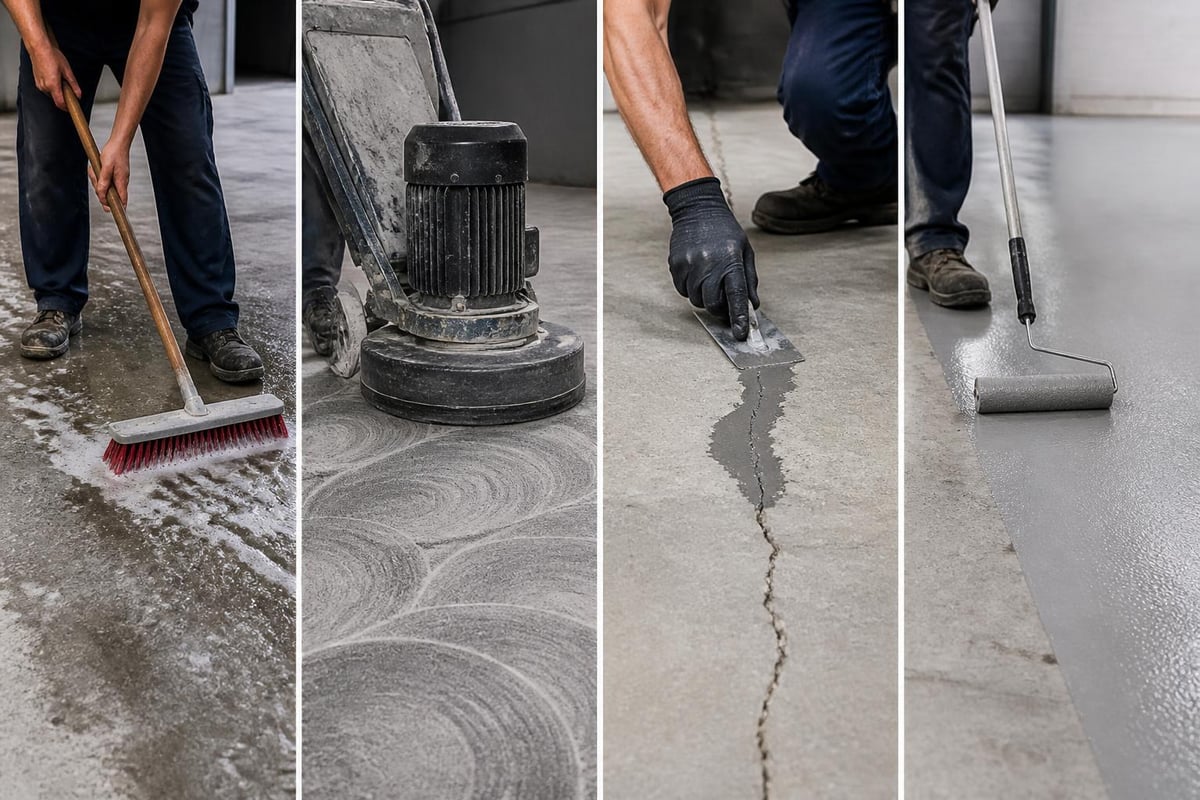
Diamond grinding creates the ideal profile for epoxy floor finish on concrete applications in commercial settings. This method removes surface laitance, opens concrete pores, and produces a consistent surface texture across the entire floor area.
Shot blasting offers an alternative preparation method, particularly effective on larger warehouse floors where aggressive profiling is required. The process propels steel shot at high velocity against the concrete surface, removing contaminants and creating anchor points for the epoxy.
Facilities with contaminated concrete may require specialised cleaning protocols before epoxy application commences. Oil and grease require degreasing agents, while existing coatings necessitate complete removal through mechanical methods.
Application Process for Commercial Environments
Installing an epoxy floor finish on concrete in commercial facilities requires coordinated execution across multiple phases. Professional installation teams must manage timing, environmental conditions, and operational disruptions.
Primer Application
The primer coat serves as the critical bridge between the concrete substrate and the epoxy floor finish on concrete topcoat. Two-part epoxy primers penetrate deeply into the concrete, sealing the surface and enhancing overall system adhesion.
Application typically occurs via roller or squeegee at coverage rates between 250-350 square feet per gallon. Primer cure times range from 6 to 12 hours depending on formulation and ambient conditions.
Base Coat Installation
Following primer cure, the main epoxy floor finish on concrete application commences. Professional teams coordinate product mixing, application, and curing to maintain wet edges and prevent visible lap marks.
Application sequence:
- Mix resin and hardener components according to manufacturer specifications
- Pour mixed epoxy onto the floor in ribbon patterns
- Spread material using notched squeegees to achieve specified thickness
- Back-roll the surface to eliminate trapped air and ensure uniform coverage
- Allow initial cure before proceeding to topcoat application
Temperature control during installation proves critical, as epoxy floor finish on concrete systems perform optimally between 15°C and 30°C. Our portfolio demonstrates successful installations across various commercial applications.
Topcoat Systems
The final topcoat provides the wearing surface for the epoxy floor finish on concrete system. Commercial applications typically utilise clear or pigmented polyurethane topcoats for enhanced UV resistance and chemical protection.
Topcoat selection depends on specific operational requirements. Warehouse flooring demands high abrasion resistance, while commercial kitchen applications prioritise thermal shock resistance and hygiene compliance.
Industry-Specific Applications
Different commercial environments place unique demands on an epoxy floor finish on concrete system. Understanding these requirements ensures appropriate product selection and specification.
Manufacturing and Factory Floors
Factory flooring endures constant forklift traffic, heavy machinery loads, and potential chemical spills. An epoxy floor finish on concrete in these settings must deliver exceptional impact resistance and load-bearing capacity.
Static-dissipative epoxy formulations protect sensitive electronics manufacturing operations from electrostatic discharge. Thickness typically ranges from 3mm to 6mm for heavy industrial applications, providing the necessary structural integrity.
Warehouse and Distribution Centres
High-traffic warehouses benefit significantly from an epoxy floor finish on concrete that resists tyre marking, abrasion, and impact damage. The seamless nature of epoxy systems eliminates joints where debris accumulates, facilitating efficient cleaning protocols.
Reflectivity represents another crucial consideration, as light-coloured epoxy floor finish on concrete installations can improve illumination levels by 30-50%, reducing energy costs and enhancing workplace safety.
| Application Area | Recommended Thickness | Key Features |
|---|---|---|
| Warehouses | 2-3mm | High reflectivity, abrasion resistance |
| Factories | 3-6mm | Chemical resistance, impact tolerance |
| Commercial Kitchens | 4-9mm | Thermal shock resistance, antimicrobial |
| Workshops | 2-3mm | Oil resistance, easy cleaning |
Commercial Kitchens and Food Processing
Food service environments require an epoxy floor finish on concrete that meets stringent hygiene standards while withstanding extreme temperature variations and aggressive cleaning chemicals. HACCP-compliant systems incorporate antimicrobial additives and seamless cove base details.
The commercial kitchen flooring sector demands rapid installation schedules to minimise operational downtime. Fast-cure epoxy formulations allow return to service within 24-48 hours.
Maintenance and Longevity Considerations
Proper maintenance extends the service life of an epoxy floor finish on concrete well beyond initial performance expectations. Commercial facilities implementing proactive maintenance protocols maximise their flooring investment returns.
Daily and Weekly Maintenance
Routine cleaning prevents abrasive dirt particles from degrading the epoxy floor finish on concrete surface. Dust mopping or auto-scrubbing removes contaminants before they cause damage.
Recommended cleaning protocols:
- Daily dust mopping or sweeping
- Weekly auto-scrubbing with pH-neutral cleaners
- Immediate spill cleanup to prevent staining
- Quarterly deep cleaning and inspection
Harsh alkaline cleaners should be avoided, as they can gradually degrade the epoxy floor finish on concrete topcoat. Neutral pH cleaning solutions maintain surface integrity while providing effective soil removal.
Long-Term Performance Optimization
Comparing flooring options helps facility managers understand expected service life and maintenance requirements. An epoxy floor finish on concrete typically delivers 10-15 years of service in commercial applications when properly maintained.
Periodic recoating extends system life without requiring complete removal and reinstallation. Topcoat reapplication every 5-7 years refreshes the wearing surface and maintains aesthetic appearance.

Cost Analysis and Budget Planning
Investment in an epoxy floor finish on concrete requires comprehensive cost analysis extending beyond initial installation expenses. Understanding total flooring costs enables accurate budget projections and ROI calculations.
Initial Installation Costs
Pricing for an epoxy floor finish on concrete in commercial applications typically ranges from $50 to $120 per square metre, depending on system thickness, surface preparation requirements, and product specifications.
Cost factors include:
- Substrate condition and preparation requirements
- System thickness and performance specifications
- Colour customisation and decorative options
- Project size and accessibility
- Timeline constraints and expedited scheduling
Larger projects benefit from economies of scale, while complex installations with extensive surface repairs or contamination issues increase per-square-metre costs.
Lifecycle Cost Comparison
Total cost of ownership incorporates maintenance expenses, replacement frequency, and operational disruptions over the floor's service life. An epoxy floor finish on concrete demonstrates superior lifecycle economics compared to alternative flooring systems.
When evaluating commercial flooring options, consider these long-term factors alongside initial installation costs. The durability and minimal maintenance requirements of epoxy systems often justify higher upfront investment.
Environmental and Safety Compliance
Modern commercial facilities must ensure their epoxy floor finish on concrete meets environmental regulations and workplace safety standards. Product selection and installation practices significantly impact compliance outcomes.
VOC Emissions and Air Quality
Low-VOC and solvent-free epoxy formulations minimise indoor air quality impacts during and after installation. Water-based epoxy systems offer the lowest emissions profiles, though they typically sacrifice some performance characteristics.
The curing process releases minimal odour with modern formulations, allowing adjacent areas to remain operational during installation. Proper ventilation still remains essential during application of any epoxy floor finish on concrete.
Slip Resistance Requirements
Flooring safety standards mandate minimum slip resistance values for commercial walking surfaces. An epoxy floor finish on concrete achieves appropriate friction coefficients through aggregate broadcasting or textured topcoats.
Testing methods include the pendulum test and wet barefoot ramp test, with results expressed as P-values or R-ratings. Commercial kitchens typically require R11 or R12 ratings, achievable through proper aggregate selection.
System Selection and Specification
Choosing the appropriate epoxy floor finish on concrete system requires matching product characteristics to operational demands. Generic specifications often result in premature failure or unnecessary overdesign.
Superior Concrete Finishes specialises in epoxy flooring solutions tailored to specific commercial and industrial requirements. Our experience across diverse applications in South East Queensland enables precise system recommendations that balance performance and budget considerations.

Performance-Based Specifications
Rather than prescribing specific products, performance-based specifications define required outcomes:
- Chemical resistance based on anticipated exposure
- Abrasion resistance matching traffic intensity
- Impact resistance suitable for equipment and operations
- Thermal properties addressing temperature extremes
- Service life expectations aligned with facility planning
This approach allows contractors to propose optimal epoxy floor finish on concrete solutions while maintaining quality standards and performance accountability.
Product Selection Criteria
| Criteria | Standard Duty | Medium Duty | Heavy Duty |
|---|---|---|---|
| Film Thickness | 200-400 microns | 400-800 microns | 2-6mm |
| Recoat Interval | 3-5 years | 5-8 years | 8-12 years |
| Traffic Level | Light foot traffic | Forklifts, light vehicles | Heavy vehicles, impact |
| Typical Application | Retail, offices | Warehouses | Manufacturing, workshops |
Professional specification development considers current operations alongside anticipated future requirements, ensuring the epoxy floor finish on concrete system accommodates business growth and operational changes.
Installation Logistics and Downtime Management
Commercial facilities cannot always afford extended operational shutdowns for flooring installations. Strategic planning minimises disruption while ensuring quality outcomes for the epoxy floor finish on concrete project.
Phased Installation Approaches
Large facilities often implement phased installations, treating sections sequentially to maintain partial operations. This approach extends overall project duration but reduces revenue impact from complete facility closure.
Fast-cure epoxy formulations allow return to light foot traffic within 12-16 hours and full service within 24-48 hours. These products prove invaluable for facilities with limited shutdown windows.
Weekend and After-Hours Work
Many commercial epoxy floor finish on concrete installations occur during non-operational hours, requiring coordination with facility management and security personnel. Weekend installations in retail environments permit full curing before Monday morning opening.
After-hours work typically incurs premium labour rates but avoids lost productivity and revenue during normal business hours. Project economics often favour expedited scheduling despite higher installation costs.
Quality Assurance and Warranties
Professional installation of an epoxy floor finish on concrete includes comprehensive quality assurance protocols and performance warranties. Understanding warranty terms protects facility owners and establishes accountability.
Installation Quality Standards
Quality control measures ensure consistent application thickness, proper cure, and adequate bond strength. Testing protocols verify:
- Dry film thickness measurements across the floor area
- Adhesion testing using pull-off gauges
- Surface hardness verification
- Visual inspection for defects or irregularities
Documentation of installation conditions, product batch numbers, and application parameters provides traceability for future reference.
Performance Warranties
Reputable contractors warrant their epoxy floor finish on concrete installations against delamination, premature wear, and material defects. Warranty periods typically range from 5 to 15 years depending on system type and application.
Warranty coverage excludes damage from improper maintenance, chemical exposures beyond specification parameters, and structural substrate failures. Regular maintenance documentation proves essential for warranty claims.
Industry Trends and Innovations
The epoxy floor finish on concrete sector continues evolving through material science advances and changing commercial requirements. Staying informed about emerging technologies enables proactive facility planning.
Sustainable Formulations
Bio-based epoxy resins derived from renewable feedstocks offer reduced environmental impact without compromising performance. These innovations align with corporate sustainability initiatives and green building standards.
Recycled content in aggregate materials and low-carbon manufacturing processes further enhance the sustainability profile of modern epoxy floor finish on concrete systems.
Smart Floor Technologies
Integration of sensors within epoxy floor finish on concrete systems enables real-time monitoring of structural conditions, temperature fluctuations, and moisture intrusion. These technologies support predictive maintenance strategies and prevent catastrophic failures.
RFID tracking systems embedded in warehouse floors facilitate inventory management and automated material handling operations, adding functional value beyond basic floor protection.
An epoxy floor finish on concrete delivers unmatched performance for commercial and industrial facilities requiring durable, low-maintenance flooring solutions. From system selection through installation and ongoing maintenance, each decision impacts long-term performance and total cost of ownership. For South East Queensland businesses seeking expert guidance on epoxy flooring for warehouses, factories, commercial kitchens, or industrial workshops, Superior Concrete Finishes provides decades of specialised experience backed by comprehensive QBCC licensing and insurance coverage. Our commercial concrete flooring expertise ensures your facility receives the optimal flooring solution tailored to your operational requirements.

Joshua Miller has over 15 years of experience in the commercial concrete flooring industry, specialising in epoxy flooring systems and polished concrete solutions for warehouses, factories, retail spaces and commercial developments. Joshua and his team work closely with builders, property owners and facility managers across South East Queensland to deliver durable, cost-effective commercial flooring systems for warehouses, industrial facilities, commercial kitchens, retail stores and large commercial developments.
Major builders and organisations Josh has led projects on include McNab, Hutchinson Builders, IKEA, Queensland Rail, University of Queensland, ADCO, Tomkins Commercial, Bunnings, OfficeWorks, Spotlight, and Anaconda.
If you're planning a project and need advice on the best commercial concrete flooring solution, contact Josh or one of the team at Superior Concrete Finishes.
-
 info@superiorconcretefinishes.com.au
-
1300 789 740
-
Connect with Josh on
LinkedIn


 Connect with Josh on